Showing posts with label Bible. Show all posts

Friday, 22 June 2012

The Secret Plot to Convert Richard Dawkins

A commentator on this morning's post reminds us that Richard Dawkins is a fan of the King James Version of the Bible. Indeed I believe (though it's only faith - I can't be bothered to find the evidence) that he was a fan of Michael Gove's absurd scheme to put a copy in ever school in the land.

It's good to know that the Good Professor has fallen into our trap, cunningly-laid over 400 years ago. For it is a little-known fact (because so few read it) that the Bible has a secret message coded into it. This code tells those "in the know" that worshipping God is a good idea, and that faith in Jesus will bring you salvation.

Sure, I know everyone who reads the Biblle superficially thinks it's a self-help book, a guide to the End of the World, contains prophecies of the Rise of the Nazis and the story of how Jesus married Mary Magdalene (leaving a heart-broken St John) and settled down in a bungalow in the Dordogne.

Some, of course, think it's just the pinnacle of the English language (along with Shakespeare and Down With Skool) But nevertheless, the code's been there all along. You've just got to know how to find it. One day soon, Prof D, you mark my words...

In other news, Burton Dasset has called to say he's landed safely. In the sort of unlikely co-incidence that suggest there may be an awful pun posted later on, he drifted due north and landed on the northern fringes of Leicestershire. The bad news is that he'll be home soon. While the good news is that the people of Coalville have adopted Beaker-style worship. They've now got the chance to revive their digging skills by raising long barrows over their dead. Nothing, in the end, is lost.

Monday, 28 May 2012

Job the Obscure

I've never quite got my head round the book of Job.

Sure, at the end of the book he's got his camels back and the sores have gone and the riches are rolling in.
But he's still lost all his sons and daughters in Chapter 1. If it's saying that you eventually get a reward for goodness in this life, there's a heck of a downside to get there.

It's like a multi-part Dr Who episode. At the end, the Doctor and his companions are generally joking around, safe in the knowledge that they've averted the latest threat to the Universe or, as it may be, Cardiff. But there's scant remembrance of the piled-up bodies of red-shirts it's taken to get to the happy ending. Oh no, it's back in the Tardis and off to Jagulon Beta.

All I'm saying is, if Thomas Hardy wrote the book of Job the ending would be more consistent with the beginning. Accepting that God is indeed able to snare Leviathan, tell unicorns what to do and generally boss the weather around, Job would say his piece and crawl under the shade of a rock to die. Obviously there's a good Wisdom-literature tradition to maintain here - so I'm not saying that it would be better, and clearly it would be less inspired. I'm just saying it would be more consistent.

Friday, 18 May 2012

Jubilee

Worrying noises from the camp.

The Beaker People are asking, if it's Jubilee this year, does this mean they don't have to work in the Doily Shed any more as the loans they took out to pay their (voluntary) joining fees are cancelled?

I've explained to them that the concept of Jubilee enshrines the rights of normal people to the land, states that, ultimately, one person cannot belong to another, and discourages a system of excessive lending as being against the best interests of society - as well as remembering that the land itself is precious, and cannot be exploited to the point of exhaustion.

Of course, Jubilee belongs to the Old Dispensation. These days we have been set free from all that.

Tuesday, 15 May 2012

The 1631 Bible - Go-No Go Meeting

In the "Scrum area" at Barker + Lucas, printers.

Barker: OK. Have we finished all the testing?

Firkin: Yes Sire. We've completed all unit testing, integration testing and User Acceptance Testing cycles.

Lucas: You mean you've read the proofs?

Firkin: Yes, Sire.

Lucas: And are there any bugs?

Firkin. Yes.

Barker: Any show-stoppers?

Firkin: Well, I've got the list here. Can we go through them? Firstly - there appear to be a number of references to unicorns. Shouldn't that be rhinoceroses?

Barker: Probably. But that's no more than a cosmetic bug isn't it? Does it affect any functionality?

Firkin: No, Sire. The unicorns are merely for descriptive purposes. At no point do they do anything that depends on them being unicorns, where a rhino might have a different effect on behaviour.

Lucas: OK. What's next?

Firkin: Well, you might regard this as more about detail rather than actual functionality but... isn't the language a bit archaic? I mean, this is 1631, after all. We're not all Lollards.

Barker: Have you actually read the "Tone of Voice" document, Firkin? It's supposed to sound archaic. This is God's word. It's not meant to be contemporary.

Firkin: OK. Right. The first chapter of Genesis appears to describe the world being created in just six days.

Lucas: And your point is?

Firkin: Well, it's a bit unlikely, isn't it? It looks a lot more than 6,000 years old to me.

Barker: Tell you what, we'll skip quickly past, pretending you didn't say that. Anything else?

Firkin: The Magnificat seems to imply that rich people will be in trouble and God loves the weak and powerless. Now I know that's what it says in the spec, but are we sure that the original requirements were right?

Lucas: I reckon you've got a good point there. But King Charles wants this Bible to ship today. So is it a cast-iron, drop-dead showstopper? What do you think, Barker?

Barker:  I reckon we'll live with it. It may make no sense to us, but it's what the Sponsor requested. And it's much the same in Revelation, so the user experience should be consistent, at least. We'll iron it out in Bible 1665, the next release, if need be. Anything else, Firkin?

Firkin: Well, just the one. It's a missing word in Exodus...

Lucas: An important word? "Moses", or "God" or something?

Firkin: Not like that, no. Just a little word. "Not".
Barker: Well, we'll go with it, I reckon. The presses are waiting, we'll just hit the deadline - and if you start putting words in who knows if we need repagination? I vote "Go'. Lucas?

Lucas: "Go".

Firkin: You're the bosses. I'll tell the boys we're going live.

"The Wicked Bible"

Saturday, 10 March 2012

Gone to Seed

That Drayton Parslow can get grumpy with you when he puts his mind to it.

All I did was ask him - why did Jacob and his sons even need to go into Egypt when he took all his seed with him? I thought there was meant to be a famine on?

He was left in the unfortunate position of having to translate the Scripture into modern English for me, to explain what it meant. He's not a happy bunny. That sort of stress could give you emerods, I tell you.

Tuesday, 21 February 2012

Cherchez les Hommes

A nice piece from Stroppy Rabbit on the Woman Caught in Adultery. A conundrum in many ways, this tale. Not least because apparently Richard Dawkins is fond of it. I've no idea if this is right - he's never shared his views with me, at least. In some ways Stroppy Rabbit has the advantage of being set free from the need to believe that Jesus actually did all the things that are attributed to him, of course. Which maybe gives her more scope to consider the meaning behind the stories.

But when I read it, I wonder where the men are in the story. Not the Pharisees, the ones who rush to judge. The men. If the woman's an adulteress, where's the husband? If he's on the scene he's not considered worthy of notice. And how about the adulterer? Where's the boyfriend? Is he more powerful - is he the boss who's been knocking off the underling's wife? Is that why the husband's not around - told to keep back if he wants to keep his job? Or did the boyfriend shin off down a drainpipe with his toga round his ankles as the baying mob of stoners came rushing in the front?

We're not told. The woman's on her own in this scene. The act of adultery is - remarkably, considering - one of which only she is considered to be guilty. She's the centre of attention, the bait in the trap, the test case. She's not a human being - she's the set of conditions with which to test Jesus.  She's the fulcrum of the see-saw that can go one of two ways - agree she should be stoned and set yourself against the Romans, agree she shouldn't and set yourself against Moses.

Jesus bends down and writes. What's he writing? We don't know. We're not told. Maybe it doesn't matter,. Because the attention's off her now - it's on him. He creates a pause; a point. And then he turns the attention on them. If you've got no sin - then you stone her.

I don't think it matters whether Jesus is sinless or not, in this instance. He could have been the biggest fornicator, drunkard, thief and cheat in the eastern Med and he'd still have been in the right. They were pointing the finger at the woman - on the principle that the woman pays. And he's pointed that writing finger right at their hearts. The scene disperses, the focus is off, and it's just Jesus and the woman - and, presumably, the husband she's got to go back to. Well, that much at least is her problem, and his. But it's not theirs.

Saturday, 28 January 2012

Multiple Marriage

I've been contemplating multiple marriage. Not for myself, you understand. When I consider the instances of woeful manhood with which I am often confronted around the Community, and the behaviour of certain rats in the past on Greek islands, pretending he was a well-connected stock-broker when he was actually an arc-welder from Walsall, I shudder at the thought of even one marriage.

No, I've been thinking about the instances of multiple marriage and concubinage in the OT. And trying to make some sense out of it all. After all, nobody's told they can't have multiple wives. And when Solomon's wives are mentioned, it's not because they are as numerous as the sand on the seashore that they are disapproved of - it's because they encourage him to worship foreign gods.
Although, let's face it, it must have been a nightmare trying to remember a thousand birthdays.

And I guess there's a natual gender inequality to these considerations of multiple marriage in Biblical times. After all, the Israelites were often at war. If the men went away to war and few came back, it would make demographic sense for the remainder to have multiple wives if you needed your population building up again. Also if a man could only have one wife in those days, it would have meant lots of unmarried women around, either sitting around in withdrawing rooms like the Misses Bennets, playing poorly on the piano-forte and leeching off their dads, or out plying a trade, if you get my drift, on the streets. I'm not saying that these life-choices weren't unfairly constrained, in our modern eyes, but polygamy was more of a symptom of the situation than its cause.

Statistically in a time of peace, there would presumably have been more men about than women - due to death in childbirth. But a woman taking two husbands would have little statistical impact. Her lifetime average number of children would barely have changed, but the number of bits of car engine laying around on the kitchen table waiting to be degreased and refitted would have gone up exponentially. So what was the point? Far better for potential husband number two - on statistical grounds, making no moral judgements here - to be out using up any spare energy in working his socks off in the fields to produce more food. Or going off on a raid to find himself a "wife" from the Moabites or wherever.

So far, so based on economic principles. Making no moral judgement, just doing. - as the Americans so amusingly say - the math. But then we turn to those two fore-runners of Our Lord himself, David and Solomon. What a pair.

For these two, it's not enough just to optimise the reproductive rate of the nation. Oh no. For David and Solomon it's about wealth, the exercise of naked power, and foreign relations.

Bathsheba already had a perfectly good husband. She didn't need another one. But David was ageing, the young men were at war and Viagra hadn't been invented - so she was just the lift he needed. The inconvenient presence of Uriah was dealt with through something which could fairly be described as conspiracy to murder and the gaining of an additional wife became a matter of abuse of power.

Solomon's wives were the result of a lot of diplomatic activity. But you have to wonder. I mean - there weren't 700 countries he had to keep on friendly terms with. Did he ever think, round about wife 400 or so, that enough was enough and he really ought to pack the hobby in now, before he had to build another extension?

Solomon's acquisition of wives was in fact far beyond the efficient level of optimal population growth. And let's face it, he'd have been worn out with the diplomatic activity - hem hem - required simply to keep each of his wives, as it were, feeling at all wanted. This is about oppression - of a man over women, and of one man over other, less powerful, men. I'm sure the under-sexed and frustrated men of Israel must have rejoiced, as they went out to reap crops and slaughter cattle to feed the multitude of Solomon's women and children - that they had such a powerful king to look up to.

And this number of wives must have been the cause of Solomon's famous expostulation "vanity, vanity - all is vanity". Mostly as he waited for his turn in the bathroom in the morning.

But enough of desert regulations under the Mosaic, Adamic and Noahic Covenants, they all cry. What of the New Testament? Well again, no condemnation of polygamy - although no real mention of it, either. Maybe the People of Israel had just got out of the habit.

But there is one class of people for whom the number of wives is specified, and I think this needs spelling out. It's in Paul's first letter to Timothy.

"Therefore an overseer must be above reproach, the husband of one wife, sober-minded, self-controlled, respectable, hospitable, able to teach...."

This is the ESV - other versions read "bishop", "elder" or minister. And if we are to take the Bible literally, what does it tell us? That the clergy must be male - and that they must have.precisely one wife each. Nobody with two, and nobody with none. One wife, and just one wife. So I'm out on my ear, Drayton Parslow is, as in so many ways, borderline (is that one wife at a time or one wife in a whole lifetime?) and Rowan Williams is absolutely fine. But the Pope, Augustine of Canterbury and a miriad of others should never have got past selection conference if Paul were one of the advisors. Meanwhile, on Biblical authority, every other man can have as few, or many, wives as they can coax to the altar. It's all fine. It says so in the Bible.

Monday, 26 December 2011

Common People

Intrigued by the work of the Bible Society's work in translating the Bible into Jamaican Patois. The article describes the effect that hearing the Bible in their own language has on its hearers.

But some aren't so happy. A bishop complains that patois is too limited to describe the nuances that English is capable of carrying:

"Even those (Patois) words that we would want to use to fully explain what was in the original, are words that are vulgar."
And yes, English is a nuanced language. Our Anglo-Saxon, Norse, French and Latin heritages give us many, finely-gradated words that can describe the same thing. That's the kind of power most other languages don't possess. I don't suppose Hebrew or even Greek could manage that.

Especially not the Greek of the New Testament, called "KOINE". Which you would translate as "common", as in "shared". You could use the sort of play on words we use in English, and interpret "common" as vulgar - but that only works in English, I suspect.

Then we have the Latin Vulgate - the commonly-used Bible. That surely must be "vulgar", given it's the Vulgate.

And then we have this comment in the 39 Articles of the Church of England - not a work I would think the Portmore Holiness Church uses, but still good advice on this kind of matter. Article 24 tells us that "It is a thing plainly repugnant to the word of God and the custom of the primitive Church, to have public prayer in the Church, or to minister the sacraments in a tongue not understanded of the people." Which I would take loosely to mean - if you're gonna have religion, have it in your own language. So if you speak English, don't learn Latin to read the Bible (I'll let you off Greek and Hebrew here). And if your language is patois - well, 'nuff said. We don't live our lives in no fancy language. And the Bible weren't written in no fancy language. So let's not read it in one.

Wednesday, 21 December 2011

Translating the Bible into Kouya

First - the important thing. Go and read Eddie Arthur on "Comment is Free" describing the way in which he and Sue worked with the Kouya people to get the New Testament into the Kouya language. Imagine the difficulty of taking a language such as koine Greek - supple, flexible, and capable of both narrative and prolonged philosophical meditation - and translating it into an oral language that is good for narrative but bad for theology. Imagine having to work out the alphabet for an unwritten language. Imagine the struggle that involves - and the desire to share the Good News that drives a six-year stay in a house with no running water.

Then reflect on the comments underneath. But not for too long. Not most of them. Although my favourite is not necessarily even an atheist comment (or "aethiest") - but it's this.

"Ah, so the Aramaic is translated to Greek, which is translated to Latin, which is translated to English, which is translated to Kouya... there is a significant passage in the Bible about the Tower of Babel...."

So yes, Jesus spoke Aramaic, and his words would have been translated into Greek. The people who witnessed his life, ministry, death and unexpected reappearance would have spoken Aramaic - but that doesn't mean the message wasn't passed on in Greek very fast, including by eye-witnesses. But then the majority of the New Testament books weren't translated from anything by the authors. The Epistle to the Romans, to name but one of many, was written in Greek. And of course, Eddie, Sue and co weren't working with an English version of the Bible that was translated from the Vulgate. So the commenter was "clever". Just wrong and misguided. But still, clever.

Eddie's blog is here. Very highly recommended. More so than the comments underneath. But then that's CiF for you.

Sunday, 18 December 2011

Christopher Hitchens and his Obedience to Scripture

Steve, in his comments about Christopher Hitchens, mentions Christian reactions to Hitchens' death. And it's fair to say they range quite widely. There are those that remark that Hitchens is on his way to the smoky place,those that hope God could find some kind of way in for anyone. I worried that those who continued to pray for Hitchens' conversion before he died were hoping for a propaganda victory - although some among us would rejoice in anyone finding God, knowing that one conversion more or less would not convince anyone else of anything.

I'd like to add one note of commendation for Christopher Hitchens - for his obedience to 1 Corinthians 15. In  it Paul is quite scathing of those Christians who would follow Jesus but don't believe in a Resurrection. He's quite clear - if Jesus isn't alive then all the persecution, all the struggle are for nothing. Paul would have no truck with a social Christianity that saw faith as above all about instilling good ethics or citizenship. What, he would have wondered, would the point be?  As Jesus would point out - even the pagans know you should look after your own, and that's ultimately what citizenship is about.

Paul's conclusion is stunning, stark and logically sound - "If the dead are not raised,'Let us eat and drink,for tomorrow we die.'" I reckon Christopher Hitchens kept that particular Biblical injunction pretty well.

Saturday, 17 December 2011

Good and bad Biblical Verses for Today's Britain

I was intrigued to hear all the discussion (such as this from Eddie) about David Cameron's address on the 400th anniverary of the King James Version of the Bible. As often happens when politicians get into religious matters, Mr Cameron has extolled Christian values while not really going into the detail of the richness of the whole Biblical tradition. He's said it's important to cling to a tradition, while making it quite clear that's not really what he does himself. Which means that what he's done is basically stood up for the good, solid, liberal, middle-class socially-responsible religion, which isn't really in the Bible at all. For we post-modernists who like to look at the interweaving and often competitive small tales of the Bible, there are actually very few big stories that emerge. Although there are some - David Cameron does encourage looking after the poor, and commends faith groups for doing so - although as one would expect of the inventor of the "Big Society" there's no suggestion in his speech of the government itself doing so.

But any enthusiastic Tory, keen to impress the management, might read the Bible uncritically, take one passage as representative of the whole, and get totally the wrong idea. So to assist any budding Tories who are interested in the Bible as a basis of Conservative values, I've provided below some Biblical concepts and colour-coded them Red / Amber / Green for their appropriateness to modern Conservatism. (I thought if I used Red / Amber / Blue it might cause some confusion).

As the man says - do the Green. Don't do the Red. Whatever you do.

GREEN (Do these)AMBER (Some context needed here)RED (Don't do these ones)
Paying taxesSingle MothersTattoos
Standing up to foreign bullies (eg Europe)Traditional Family ValuesLarge public-sector infrastructure projects
The Big SocietyBeing tough on crimeLabour-style leadership selection
Investing for an export-lead recoveryDealing with anti-social behaviourTax avoidance
10pc tax rate (just not yet)Capital punishmentPoliticians interfering in religion

Saturday, 26 November 2011

Tearing Open the Heavens

If only you would tear open the heavens and come down!
Mountains would quake before you like fire igniting brushwood or making water boil.
If you would make your name known to your enemies,
the nations would tremble in your presence. (Isa 64:1-2, CEB)

It's easy to scoff (I've found) at yesterday's news regarding little Gove and his issue of the King James. Though I suspect his idea was actually meant well. 400 years of a fine piece of literature are worth celebrating. Even if it's not the earliest, the most accurate or the most readable English version of the Bible. It's just that the idea of Gove writing a few words in the frontispiece blows the whole thing for me. And I'm unsure whether, like the original, the Government is planning to issue the Apocrypha.

But it's also something so kind of retro. It's almost like a recreation of the original concept where the idea was for one Bible to be put in every church in the land. But that's not because they were in need of an English Bible - they'd had those for ages. Rather it was James's way of imposing some uniformity and a bit of respect for those in authority - after all, the Geneva Bible was also available, but it had a habit of referring to king as "tyrants". And writing seditious comments about the authorities in the margins. And you couldn't have that, could you? After all, Job 6:23 (KJV) says " Or, Deliver me from the enemy's hand? or, Redeem me from the hand of the mighty? " - whereas Geneva says "And deliuer me from the enemies hande, or ransome me out of the hand of tyrants?". And you start to guess why James might prefer a more... more gentle reading of the activities of the powerful.

And so Dave's Government have decided that they will reproduce that act of conformity by issuing the copy of the Bible that was meant, among other things, to ensure we knew our place. As I say, I'm sure they're not thinking like that. But that's how James's Government must surely have thought.

Some people believe that authorities think religion is good, because it keeps the populace well-behaved and kindly. Let's face it, the Big Society, if it ever appears, will need to be heavy on support from religious groups. But if the Mighty/Tyrants were really to use the Bible to enforce public conformity, they'd have to remove a few bits. Like anything to do with the mis-use of power. Or money. Or, these days, care for foreigners. Or, most of all, anything that suggests there is a higher authority than the Government. So maybe the ultimate Bible issued by a Government would just be Romans 13. Apart from that, the Bible is a collection of books that is a threat to the authorities. Their rule is flaky, their kingdom temporary and their hopes destined for flames - as everyone that ever tried to cling to power discovered, from Gaddafi to Maggie to Tiberius Caesar - one way or another it all goes west in the end. And we can't depend on their competence forever.

"O that you would tear open the heavens and come down". The world will dissolve in ashes, the 5-year plans indefinitely suspended. The secret police forces will be in the open. The prisons thrown open, the wrongs righted. The tyrants will flee. They all want stability - whether a Big Society where everyone's in it together, another 5 years, a single currency, the next great push, or a boot stamping on a human face - forever. They all want stability because that means they'll always be in charge. But the world's not like that. God's not like that,. The future's not like that. They all come to an end - human, fallible, fragile as they are, no matter if they think they're gods.

I remember a moment of wonder in politics - in 2002. Estelle Morris stepped down as Education Secretary, admitting she wasn't up to the job. The Guardian list a couple more examples.  Oh that other leaders, managers, politicians would admit they weren't up to the job. Then they might do the jobs better, remembering that their downfall is coming, their jobs are merely temporary - and they're not good enough for them anyway.

The Bible from Cover to Cover

Drayton Parslow's really annoyed with me about yesterday's "Gove" preface.

He'd accuse me of blasphemy. But trouble is, he can't work out whether that bit of grovelling* to King James I, at the start of the Bible he authorised, is technically part of the Good Book or not. My argument is, how could it be? It wasn't written in Biblical times. And the majority of the people who follow Drayton's rather extreme views on the AV are Americans, who are very determinedly replublican (with both a small and big "R", for the most part).

Drayton's not so sure, feeling that in some way the whole set up from cover to cover must be inspired. I counter by suggesting that, since God's responsible for the whole universe, he could apply the same arguments to Alice's Adventures in Wonderland.

So he's gone off to commune with his Maker. I'll see if he's come up with anything coherent later.

* To be fair to the Translators, having seen what James I arranged to be done to traitors I think I'd have a neat line in grovelling in their shoes too.

Sunday, 13 November 2011

The Central Message of the Bible

Peter Kirk at Gentle Wisdom suggests that David Cameron's selection of Php 4:8-9 is not, as Mr Cameron suggests, the "central message of the Bible".

Finally, brethren, whatsoever things are true, whatsoever things are honest, whatsoever things are just, whatsoever things are pure, whatsoever things are lovely, whatsoever things are of good report; if there be any virtue, and if there be any praise, think on these things. 9Those things, which ye have both learned, and received, and heard, and seen in me, do: and the God of peace shall be with you.


But I suspect that David Cameron has actually been quite cunning in his choice here. What he has chosen is a set of words which just about anyone of any faith can sign up to. You've got to admire his tact.

But if some nice words about being good aren't the central message of the Bible, what is? Is there a central message at all?

If you think of Joshua, for example - what was the central message of the Bible for him?  Something, I would suggest, like "Kill the Canaanites. No, all of them. Look - you've missed one."

For Drayton Parslow next door, the central message of the Bible might be along the lines of "We're so crummy we deserve for God to smash us into small pieces and braise us over a slow fire. Forever. But Jesus died to take all that pain for us. Better keep the faith or it's slow-fire time."

While a universalist (I'm thinking in general preference, rather than the denominational sense) might prefer "God loves you. All of you. Try and be good, but you'll go to heaven anyway. In fact, - be bad. You might as well. Go on, have some fun. Kick a puppy for me."

While a post-modernist might say that the central message of the Bible is that there are no central messages to the Bible. There are lots of messages - about killing Canaanites, about God liking some of the Canaanites after all, about establishing a separate people to be holy, about salvation - that Paul and Mark and Moses and Isaiah (all three of him, if that's your bag) all have different messages and that what we hear is not a single message but a hubbub of messages, sharing some common themes.

If we learn anything from all this, it is that the central message of the Bible is pretty well whatever you want it to be if you put your mind to it. So I reckon David Cameron's not got it all wrong. But I think I'd put the words "Jesus" and "Saves" in there somewhere. I reckon they're quite important.

h/t to David Keen for alerting me to this - but not in the cartoon in the blogpost I've linked to. I just think it's funny.

(And I should add that kicking puppies is not good, and definitely not part of the central message of the Bible.)

Saturday, 5 November 2011

Jesus and the Apocryphal Apocalypse

Just a quick thought. And I may be missing the point here. Apparently according to the Jesus Seminar, Jesus didn't actually tell the parable of the Wise and Foolish Virgins. We can know this because it's about the End Times. And Jesus didn't talk about the End Times. And the reason we know this is because all the stories about the End Times in the Gospels, weren't told by Jesus. Because he didn't talk about the End Times.

I'm probably missing something here, but it strikes me that the Jesus Seminar may have been just a teensy-weensy waste of time. Which is clearly true, because I just said it.

Wise and Foolish Virgins

The different translations of Matthew 13 tell you just how much using the right translations and understanding the social context matters.

To a 21st reader of the King James, the context would be clear. Coming to the text fresh, one would assume that in a first-century environment the bridegroom is arriving to marry the virgins - or as many, apparently, as are well-equipped with lighting equipment. Why, looking at a lifetime of marriage as a whole, the bridegroom might decide that having a working lamp is a particular recommendation, would never be clear under this hypothetical reading. But the lack of any mention of a bride in the parable might also point this way. Maybe he was going to choose the one with the best torch?

But the NRSV interprets the virgins as "bridesmaids".  This strikes me as indeed an interpretation - an assumption has been made that this is their function at the wedding feast. I suppose - for we don't have the information - that their job was to stand around holding lamps, in which case the interpretation "bridesmaids" would be wrong - and the groom's reaction in not letting them in would be quite reasonable. After all, if you're at a function with no unction, that's a pretty bad junction.

So the best I can conclude is, I don't know. Perhaps the moral we can draw from all this, in this modern world, is that you should always keep your environmentally-friendly rechargable torch charged up. Or maybe invest in a wind-up one. Then you will know, at whatever hour the groom arrives, that you'll have a bit of light and you won't get locked out.

Now we will sing "This little light of mine". Which, having an upbeat and a slow way of playing it, can be found both at the front and back of Burton's new hymn book.

Thursday, 3 November 2011

Breaking the Rules

I have sinned. Inadvertently, but is that an excuse?

I saw the so-called "Archdruid" from the Great House this afternoon. We exchanged a few pleasantries, and I pointed to a bird of prey circling overhead.

"Oh, look at that buzzard," I remarked.

"Buzzard?" said Eileen, "that's a kite."

The temptation was there, and I regret to say that I blundered into it.

"Oh?" I replied, "how do you know?"

My fall was at hand.  Eileen explained how the tail shape of a kite is very distinctive, marking it off from the buzzard.

"Get thee behind me, " I exclaimed, "thou hast caused me to fall foul of 1 Tim 2:12."

But it was too late.

I am going off to repent for a while now. I may be some time.


Red Kite by  ThKraft under Wikimedia commons

Sunday, 30 October 2011

Living by Numbers

It is without doubt that every word of the Good Book is God-breathed. Every paragraph a divine message. Each clause and semi-colon pondered in the Wisdom Ineffable in the long years before Time began. And some of the truths are quite obvious. For examples, the meanings of that section outlawing transvestitism is self-evident. Whereas where there are sections that talk about mixing different materials in making cloth, or putting fringes on your clothes, clearly we have to understand the context. We must try to gather together the meaning that God was intending for us today, who wear poly-nylon shirts and do not need fringes. And other sections are more complex still, and require great prayer and effort to understand

And so, my friends, today I completed my great sermon on the secrets that have been encoded into the Book of Numbers. It is well known, I believe, that the Book of Numbers has a lots of numbers in it. And what does it matter to us if there were forty and six thousand and five hundred of the tribe of Reuben, but fifty and nine thousand and three hundred of Simeon? Well, after years of study I believed I had apprehended the meaning of every number in Numbers. And I revealed them to my congregation this morning.

Brothers (and sisters, suitably-instructed by a male relative or pastor, for this is strong meat) - I cannot pretend that the exposition of every single number in Numbers, and its meaning, is by any measure a short exercise. Our service started at 10am as normal, and by the time I was reaching the final set of numeric meanings I noticed how late it was becoming.

And so I suggested to my flock that, given the lateness of the hour, we could simply allow our morning devotions to be joined directly onto the evening praise that sanctifies our rest. Imagine my shock and surprise when they stormed the pulpit, ripped my sermon to shreds - the last twelve points as yet unpreached - and ran out of the chapel to find something to eat. Ah me, I will put it down to low blood sugar. Next time I have a serious sermon to preach, I will have to arrange to have caramel crème biscuits (not bourbons, which could over-excite) passed around after every few points, to enhance the congregational stamina.

Saturday, 8 October 2011

Euodia and Syntyche

Good news that an ancient Greek scroll, which I have conveniently found in the toolshed, has shed new light on the situation St Paul refers to in Philippians 4. Who would have thought that, even in those days, some church council secretaries wrote out every word spoken in the meetings, no matter how relevant or otherwise?

It turns out that Syntyche's original grievance was when Euodia presented a gourd at the Philippi Harvest Festival. Euodia complained that she always gave the gourd. Syntyche pointed out that the church was only a few years old, so that was a wild use of the word "always".
From then on, it would appear, Syntyche was "a bit off" with Euodia. At the Philippi flower festival, Euodia's fuchsias were mysteriously moved to the back of the display. While in a piece of alleged skullduggery, Syntyche was unexpectedly voted out of her position in the Mothers' Union.

Things came to a head at the Christmas Faith Lunch. Annoyed by Syntyche turning up with a bigger quiche - and putting currants in the snails to make them extra posh - Euodia refused to pass her the bread. Syntyche went around complaining about Euodia - "look at her, going around making out she's so humble. Well, I'm humbler than she is..."

The trouble spread to their families. After a minor jostle in the Athens Arms over whose mother made the better jam, Euodia's eldest told his opposite number, "don't be so touchy, Son". While in the commemorative 10 Years of Philippi Church booklet, the engraving of the "church family" clearly showed Euodia's fingers making "rabbit ears" behind Syntyche.

That these two matrons of the church were able to maintain this rivalry at a time when the church was facing persecution, heresy and schism is some kind of tribute to them. The Greek language has changed, the Bible is now preached in English and is even available electronically. The note Paul dashed off on borrowed parchment during his imprisonment has been elevated to the status of Holy Scripture. But one tradition - that of rivalry and petty quarrels underming the Gospel of peace and unity - has been maintained through 2,000 years. I believe we should all feel humbled.

Friday, 7 October 2011

Jesus and the Giant Picnics

Down in the Great Hall, it would appear the battle is still raging as to whether the headmaster is going to get off with the gym-teacher's wife, and whether cheating is ever justified in sport. Who knew Waterloo Road could be so theological? And I'm told that the discussion has been going on all night. They're going to be grumpy out there for Pouring Out of Beakers - not least because it's a foul day with mizzling rain. And the Moot House is still full of the scaffolding from Young Keith's surprisingly literal reconstruction of the Fall of Jericho, so out of bounds until the hire company comes back.

Staying out of the way, I'm settled with my kippers and acorn coffee next to a bit of a fire I've lit to chase away the early-morning autumnal blues. But kippers by a fire - excepting the question of whether you've got to have them in Texas, where everyone's a millionaire - takes me back to another early-morning fish meal on the beach-side in Galilee, with the world's least likely celebrity chef - the one who was supposed to be dead.

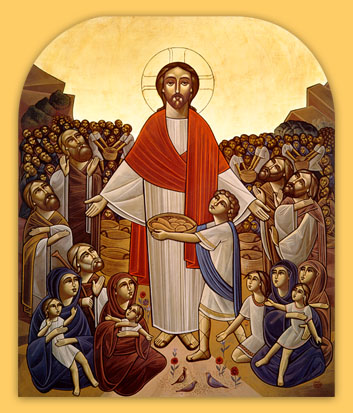
And in a chiasmic kind of way, that you wouldn't notice yet if I hadn't just boasted about the oh-so-clever construction of this piece, that picnic always takes me back to that other one (or two) where Jesus feeds 4 or 5 thousand men (plus the women and children - who aren't counted but are important enough, at least, to be remembered).

And that leads me onto the different ways of looking at these stories. For some such as Drayton Parslow - and myself, as it happens - believe that these are stories of real miracles. But others see it differently. The most commonly-held "less literal" way of believing in the stories is probably what I might call the "Galilean Bring-and-Share" tradition.

In the "Galilean Bring-and-Share" story, the exasperation of the disciples is mollified when it is discovered that a large proportion of the 5,000 men (and associated offspring and spouses) have in fact brought their lunch along after all. Opening the Roman-Era Tupperware (c) they doled out the  kippers and cobs they had remembered to bring along. I will note that it's an odd thing that, although Jesus's teaching seems to have lasted all day on many occasions, his actual recorded sermons are in fact very short. But the point is that from a dramatic work of power that awes all around and leaves baskets full of uneaten food, now we have a little moral tale about the importance of generosity. Giving liberal preachers the world over the chance to prove their cleverness by showing the glaring inaccuracies in the Bible to their flocks, while also letting them encourage a decent display at the next "Faith lunch".

And to this I say Phooey. The point of the story is not that when you set off into the wilderness you should remember to take a packed lunch in case the bloke next to you is not so possessed of forethought. The point of the story is that Jesus is divine and capable of doing miracles. If you want to say it didn't literally happen - don't keep the story and take out the miracle and make it some pious bring-and-share tale. Chuck out the narrative and suburban explanation completely and say - the story shows simply that Jesus is divine. Multiplying food in unlikely locations is what supernatural beings do. So the disciples are trying to tell us that Jesus is the Son of God, by telling us he made lots of bread and wine when it was needed.

So do it that way. It's got great, simple, mythic power. And somebody can still read that and have a choice whether Jesus is the Son of God or not. Or tell it the old way. And the choice is there - it happened or it didn't, he's the Creator walking on earth and a human being - or he's not. But don't fall down the middle and pretend it's about not forgetting your sandwiches and being generous to others. Because it's not.

And back to that first story - it's a brilliant story. The surprise revelation, the remembrance of old things renewed. The human closeness to the supernatural conqueror of death. Again - take it as a literally and mythically true story. Or take it as a mythical story and celebration of Communion. But you're not gonna explain this one away by claiming it's about the communal importance of barbecues.