Saturday, 8 October 2011

Euodia and Syntyche

Good news that an ancient Greek scroll, which I have conveniently found in the toolshed, has shed new light on the situation St Paul refers to in Philippians 4. Who would have thought that, even in those days, some church council secretaries wrote out every word spoken in the meetings, no matter how relevant or otherwise?

It turns out that Syntyche's original grievance was when Euodia presented a gourd at the Philippi Harvest Festival. Euodia complained that she always gave the gourd. Syntyche pointed out that the church was only a few years old, so that was a wild use of the word "always".
From then on, it would appear, Syntyche was "a bit off" with Euodia. At the Philippi flower festival, Euodia's fuchsias were mysteriously moved to the back of the display. While in a piece of alleged skullduggery, Syntyche was unexpectedly voted out of her position in the Mothers' Union.

Things came to a head at the Christmas Faith Lunch. Annoyed by Syntyche turning up with a bigger quiche - and putting currants in the snails to make them extra posh - Euodia refused to pass her the bread. Syntyche went around complaining about Euodia - "look at her, going around making out she's so humble. Well, I'm humbler than she is..."

The trouble spread to their families. After a minor jostle in the Athens Arms over whose mother made the better jam, Euodia's eldest told his opposite number, "don't be so touchy, Son". While in the commemorative 10 Years of Philippi Church booklet, the engraving of the "church family" clearly showed Euodia's fingers making "rabbit ears" behind Syntyche.

That these two matrons of the church were able to maintain this rivalry at a time when the church was facing persecution, heresy and schism is some kind of tribute to them. The Greek language has changed, the Bible is now preached in English and is even available electronically. The note Paul dashed off on borrowed parchment during his imprisonment has been elevated to the status of Holy Scripture. But one tradition - that of rivalry and petty quarrels underming the Gospel of peace and unity - has been maintained through 2,000 years. I believe we should all feel humbled.

Body and soul

Unlike the Archdruid, I follow a truly masculine game, where men in beards can hold each other tightly, or scamper across the sward, or stand around with their hands on their hips watching their colleagues kick oval balls, or just jump lithely into the air with their peers.

And I'm sure that our Rugby (Union) playing boys will show their round ball kicking compatriots how it should be done against the continental foe. No draws today, I'm certain. Though, half an hour in, it looks like we might lose valiantly instead.

Anyway, before the kick-off, one of the commentators suggested that the players needed to put their bodies and souls on the line for their country.

And I thought: bodies, yes. But souls? Has the Archdruid done some sort of sponsorship deal with Martin Johnson that I've not heard about whereby she has agreed to excommunicated the team if they lose? I know she has an entrepreneurial streak, but surely that's a step too far?

Friday, 7 October 2011

Macedonia and Montenegro - an Apology

In my earlier posting, I appear to have confused Macedonia with Montenegro. Macedonia is where Alexander the Great came from, Montenegro drew 2-2 with England. That's how you tell the difference. I would like to apologise to both nations. I would also like to stress, after Hnaef has pointed out my other mistakes, that neither country is famous for drinking sangria, eating spaghetti or dancing Cossack dances while wearing furry hats.

The bad news is that I've received a phone call from the England Football Supporters' Club telling me that I'm a disgrace. Still, on the bright side, UKIP want to know if I'd like to stand as an MEP at the next European elections.

On another matter, I note that Wayne Rooney has been sent off for a silly foul, and could miss the next three games. I guess he must have suffered a rush of blood to the hair. Sorry, head. Head.

Hope springing eternal

Come on England.  It's only Macedonia. And what have they done since 323BCE? (that's "Before Capello's England").

Surely we can beat a bunch of spaghetti-sucking blokes who dance around in furry hats while drinking Sangria? After all, while they were still building the pyramids we were already developing the concept of overlapping full-backs. (Hnaef - can you check this?).

Frankly we're nailed-on certs. Macedonia may as well go home.

Oh. They are at home?

Good old England! Plucky losers as ever! That Capello's rubbish. We're never gonna win anything till we get an Englishman in charge - or else a Dutchman - you know, like Steve Mcclaren. 

(Continues forever)

Very, very slow

I was chatting to Drayton Parslow this morning, who was rather energised and excited. This is never a good thing, and usually means that we have to send Young Keith round to confuse him a bit until he calms down. But, fool that I am, I asked Drayton what he was excited about. And he thanked the Archdruid for giving him an idea.

Now, Drayton actually appreciating anything that the Archdruid has said is something of a rarity, so I enquired further, and he said that he'd been inspired by a comment she'd made that "although Jesus's teaching seems to have lasted all day on many occasions, his actual recorded sermons are in fact very short". And what, I asked, was so inspiring about that?

And then he explained that he often worries that his sermons are too short.

It took me a couple of minutes to recover, pick myself up from the floor and check what he'd actually said. I even got Mrs Hnaef round to check that I'd understood him correctly, and got him to repeat his comment. And when I'd picked _her_ up off the floor (I really should have thought to stand behind her), I thought I'd better try to understand what he was on about. He, Drayton Parslow, is concerned that he doesn't speak for long enough when he's preaching. And, I asked hopefully, he's now realised that he can preach for a shorter time, because the Archdruid noted that even Jesus didn't always speak for very long?

"Ah, no, "he responded: "get thee behind me, Satan."

What? I continued, and then realised that I'd just cast doubt on the literalness of Scripture, at least in Drayton's head. Easily enough for a "getting behind him", as we sometimes call them in the Community.

"What I realised was that even if the words recorded by Our Lord are few, if he took all day to speak them, then he must have been speaking _very_ slowly. And I mean _extremely_, very, very slowly. So I'm going to see if I can't at least quadruple the length of my sermons from now on by taking a very long time over each word. It's the Biblical thing to do."

I told Young Keith. And he's started a sweepstake - not on the length of the sermon, but on how long it is before Drayton is preaching to himself. I've taken "never", because if Young Keith is there to record the time, he'll have to stay and listen, right? See - I'm not so dim after all.

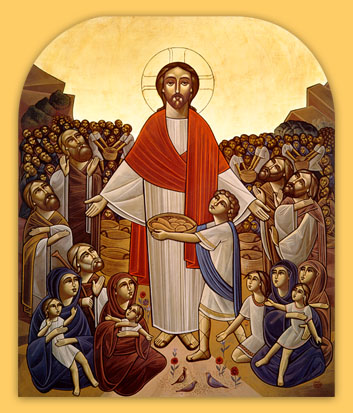
Jesus and the Giant Picnics

Down in the Great Hall, it would appear the battle is still raging as to whether the headmaster is going to get off with the gym-teacher's wife, and whether cheating is ever justified in sport. Who knew Waterloo Road could be so theological? And I'm told that the discussion has been going on all night. They're going to be grumpy out there for Pouring Out of Beakers - not least because it's a foul day with mizzling rain. And the Moot House is still full of the scaffolding from Young Keith's surprisingly literal reconstruction of the Fall of Jericho, so out of bounds until the hire company comes back.

Staying out of the way, I'm settled with my kippers and acorn coffee next to a bit of a fire I've lit to chase away the early-morning autumnal blues. But kippers by a fire - excepting the question of whether you've got to have them in Texas, where everyone's a millionaire - takes me back to another early-morning fish meal on the beach-side in Galilee, with the world's least likely celebrity chef - the one who was supposed to be dead.

And in a chiasmic kind of way, that you wouldn't notice yet if I hadn't just boasted about the oh-so-clever construction of this piece, that picnic always takes me back to that other one (or two) where Jesus feeds 4 or 5 thousand men (plus the women and children - who aren't counted but are important enough, at least, to be remembered).

And that leads me onto the different ways of looking at these stories. For some such as Drayton Parslow - and myself, as it happens - believe that these are stories of real miracles. But others see it differently. The most commonly-held "less literal" way of believing in the stories is probably what I might call the "Galilean Bring-and-Share" tradition.

In the "Galilean Bring-and-Share" story, the exasperation of the disciples is mollified when it is discovered that a large proportion of the 5,000 men (and associated offspring and spouses) have in fact brought their lunch along after all. Opening the Roman-Era Tupperware (c) they doled out the  kippers and cobs they had remembered to bring along. I will note that it's an odd thing that, although Jesus's teaching seems to have lasted all day on many occasions, his actual recorded sermons are in fact very short. But the point is that from a dramatic work of power that awes all around and leaves baskets full of uneaten food, now we have a little moral tale about the importance of generosity. Giving liberal preachers the world over the chance to prove their cleverness by showing the glaring inaccuracies in the Bible to their flocks, while also letting them encourage a decent display at the next "Faith lunch".

And to this I say Phooey. The point of the story is not that when you set off into the wilderness you should remember to take a packed lunch in case the bloke next to you is not so possessed of forethought. The point of the story is that Jesus is divine and capable of doing miracles. If you want to say it didn't literally happen - don't keep the story and take out the miracle and make it some pious bring-and-share tale. Chuck out the narrative and suburban explanation completely and say - the story shows simply that Jesus is divine. Multiplying food in unlikely locations is what supernatural beings do. So the disciples are trying to tell us that Jesus is the Son of God, by telling us he made lots of bread and wine when it was needed.

So do it that way. It's got great, simple, mythic power. And somebody can still read that and have a choice whether Jesus is the Son of God or not. Or tell it the old way. And the choice is there - it happened or it didn't, he's the Creator walking on earth and a human being - or he's not. But don't fall down the middle and pretend it's about not forgetting your sandwiches and being generous to others. Because it's not.

And back to that first story - it's a brilliant story. The surprise revelation, the remembrance of old things renewed. The human closeness to the supernatural conqueror of death. Again - take it as a literally and mythically true story. Or take it as a mythical story and celebration of Communion. But you're not gonna explain this one away by claiming it's about the communal importance of barbecues.

Thursday, 6 October 2011

The Year Dies

Our Beaker ancestors worried about the changing seasons. Well you had to. Agriculture depends on the sun. You need to know when the sun's powers are declining - so from June 21 onwards or thereabouts you knew it was time to stop sowing and get ready for reaping. In the despairing depths of midwinter, even as you looked forward to another couple of months of cold, the winter solstice was the promise that things would change. That one day they would get better. Apparently in the Southern Hemisphere, someone was having the same idea.

But tonight is another kind of time. Although driven by the sun, it's not predictable like a solstice. It's not even  got the hazy precision and doubtful utility of knowing the equinoxes. And it's a day of uncertain prediction and unsure definition. Here in the Beaker Community, we call it "the day the year dies". And this year, I'm calling it for today.

The rain's been falling all day. Outside the sky alternates between gray cloud yielding heavy showers, and clear skies revealing the autumn skies - when the Plough hangs in its sinister way over the landscape (albeit round here it's struggling against the glow off the M1).

Down in the Great Hall the Beaker People are engaged in an important debate - if God is good and omnipotent, how can you explain Waterloo Road? And I should be offering spiritual solace and inspired guidance. But here in my study, the curtains are drawn and a fire warms the room. Meanwhile outside wind form the north-east chills the air. The year has died. It may drag itself along for a few months yet, but we know it's died.

And so I throw a broken-up pallet on the fire and revel in the blue, chemically-enhanced flames. I really must check what preservative they've used, next time I collect a job-lot. Still, it's environmentally friendly and on the bright side all the chemicals are going up the chimney. Autumn is a time of dark, of dying, of predictable despondency. Winter, a time of sleep and quiet. It's Spring that I really fear. Because who can control that? New life is a riot - you can't nail that.

Tip of the pointy hat to Pagans for Archaeology Facebook Group for the link to the article.

Happy 200th

A quick congrats to Nancy who has managed 200 blog posts. Yes, I know that's less than this blog (or fewer, as Hnaef would point out). But Nancy manages to think on hers, whereas I can spin it out by such techniques as blogging without thinking, or blogging congratulations to other blogs on reaching milestones.

The Great Irony of Graham Dilley

So deeply saddened by the passing of Graham Dilley. In his era all English cricketers either sported dodgy car-salesmen moustaches or looked like they'd wandered straight out of the bar to have a bash at going in at Number 4. Or else they seemed so old that only direct injections of Deep Heat stopped them standing immobile at Third Man indefinitely. But Dilley strode around the pitch like some blond minor deity.

The irony is that his career is defined by a match early on. And that he is remembered best for a match in which he was only the third most important contributor. He made 56 in that wonderful mad partnership with Ian Botham that stopped the '81 Headingley Ashes Test being a rout. And he was the bloke bowling from the other end while Bob Willis, every arthritic joint replaced with titanium, creaked in to bowl the Aussies out. And I remember how the joyous freedom of his batting in that Test - his lesser skill - contrasted with the odd, deliberate, almost ponderous way he bowled.

And given the choice - cricket being the team game that it is - of your most notable performance being taking 10 wickets in some forgotten win over Bangladesh on a rain-soaked Old Trafford - or of being the third most remembered player the most exciting cricket match ever played - then even when that Test is so often remembered by another player's name - I know which I'd choose. That wild, happy afternoon in Leeds, every time.

God bless you, Graham. May you now have a pair of boots that you will never wear out.

Wednesday, 5 October 2011

If Job Interviews were like the X-factor

Mr Walsh: So then - Kayleigh. Can you tell me about your current job?

Kayleigh: It's as an administrative assistant in the buying department of a national fish wholesaler.

Mr Walsh: And can you tell me about a particularly challenging project you've had to undertake there?

Kayleigh: I had to investigate the relative cost prices of haddock and cod from different suppliers and fisheries, and summarise them into a table. An Excel Table that I embedded into a Word document. A Word document containing words that I wrote myself, straight from the heart. My own words.  Mr Walsh, I gave that document everything I had. It was the most important thing I ever did. I put my heart and soul into that project, Mr Walsh. [Cries]

Mr Walsh: And would you say that your made that document your own?

Kayleigh: It was my own. I even put my name at the top of it. And I tracked changes, and everywhere it had been revised it said "Kayleigh Daly". And Mr Walsh - that was my document. If that document ever belonged to anyone, it belong to me. And if any document ever belonged to me - it was that document.

Mr Walsh: You owned that document?

Kayleigh: It was owned by me more than it was ever owned by anyone else. [Breaks down]

Mr Walsh: So, Kayleigh - why do you think you would make a successful administrative assistant at Amalgamated British Prawns?

Kayleigh: I just want this job more than anything else I've ever wanted in my life. I don't want to be a nobody - I want to be a somebody. Somebody who was born to buy prawns. [Sobs]

Mr Walsh: So why do you want to buy prawns?

Kayleigh: I think about the ones waiting for me, back at home.

Mr Walsh: Your children?

Kayleigh: My cats. Binky and Mr Flat-Face.

Mr Walsh: Mr Flat-Face?

Kayleigh: He was born with no depth perception. Every time he tries to jump onto a wall he smashes straight into it. I owe it to Mr Flat-Face. The thought of him jumping onto my lap - and missing - when I sit down this evening, and saying to him - "Mr Flat-Face. I'm afraid it's value-price dry cat food again" - when it could be the delicious off-cuts of prawn at discount prices that I'd be entitled to buy if I worked here.... [Sobs] I just don't think I could do that to him. And that's why this job means everything to me.

Mr Walsh: Well thanks, Kayleigh. But finally, tell me - I take it you're named after the Marillion song?

Kayleigh: That's right. My parents loved it - "Chocolates melting on a playground wall..."

Mr Walsh: I think you'll find that's "Chalk hearts"?

Kayleigh: Oh, is it? Do you think maybe I'm.... a little hard of hearing? Mr Walsh - is it true that every day I'm overcoming a drawback I never even knew I had?

Mr Walsh: That's some back-story, Kayleigh. And you really owned this interview. I think we've come on a real journey. But there were twenty-four people applying for this job, and I can only put four through to the next round of interviews. Kaleigh..... It won't be you..... who I'll be disappointing. You're through to the next round!

Kayleigh: [Breaks down in tears] I did it for Mr Flat-Face. Oh, thank you, Mr Walsh. [They hug]

If ministerial selection was like the X-factor

Ministerial Selection is a long and searching process. If you're going to ordain someone - or however you identify your leaders - it's important that you do your best as an organisation to get it right. They are to be conveyors of grace and visible signs of the Kingdom in your local communities. And while some might do that in ordained ministry, others might actually be better-suited to other callings in the same kingdom.

For some Methodists, the period of time spent in discernment, training and probation is longer than a typical working life. While in the Church of England, after a long period of discussion with a DDO and several interviews with assessors, vicars and bishops, the candidate is sent off to Bishop's Advisory Panel. Here they will endure several - often very challenging - interviews on their spiritual, pastoral and intellectual attributes, which they will undergo while having very little sleep due to the hard beds, self-doubt and sound of trains going past in the middle of the night. After which, if they are recommended, they face several years of education, training and further self-doubt, and then a curacy before they are a fully-fledged vicar.

Beaker People have to wear the Sorting Hat to determine which theological college or course they should attend, after which we make them do menial work for several years to try and break their spirit. Charlii, for example, has spent the last four weeks cleaning the lavatories and replacing the wiring in the Great House - and sweeping out the cobwebs in the attic for us. However I'm concerned she still needs to learn some humility.

But what I'm saying is that the whole thing is very important, very serious and often very deeply emotional. People can shed real tears and endure real doubts and pain along the way - knowing that before them they still have a long hard slog. Wouldn't it be easier if.....


The audition stage

Contestant: I am the God of Hell-fire. And I bring you....
Gary Barlow: Next.


Dermot: Ant, can you please get off the stage? You're in the wrong show.
Ant: What? You mean you're not Dec?


Methodist Superintendent, London South Central:  Jerome, for a moment you had us wondering - that move with the pelvic thrusts - was that really suitable to a largely ageing and middle-class demographic? I'm sorry. It's a "no" from me.


Leon(contestant): I really know that if I want to be somebody instead of nobody, I have to show that I've the heart and the guts and the determination and the drive. And I really hoped that by hopping up on stage here and signing "I will Survive" for a couple of minutes, I might by-pass all the hard work involved...

Louis Walsh: Justin, you really really owned that reading from Jeremiah. It's a "Yes" from me.

Bishop of Chingford: Randolf, you've really split the judges here. Yes, we like your work. Your compassion and love for people - that's just shone through. But your universalist theology and your assertion that "God's just a figment of our imagination" - are you right for the Church of England? So far it's 2 Yes's and a No...

Drayton Parslow: Miriam, you may "believe you can fly". But I call that putting the Lord to the test. It's a "no" from me.


URC Moderator of the Welsh Borders: Gandalf, are you sure you wouldn't be better off watching "Merlin" on the other side?


The Boot Camp


The Revd Sinnitta:  Barbara, you told us you were really feel called to ministry because you wanted the opportunity to tell everybody what to think, in an environment where you could not be contradicted. I'm sorry. You're not going through.


Archdeacon of Notting Hill: Paula, you've been on a journey. From the moment we discovered you were a single mother with a tragic backstory, there's been no doubt. You're through to the Live Final.


Gary Barlow: Jason, if I put you through, it's gonna take all your guts to go through with it. Some Sunday evenings you may be putting on a live performance in front of three or even four people. Can you live with that?


Vicar of a small benefice who had a bit of time on his hands: I always knew it was a mistake dividing the Boot Camp up between "Boys", "Girls" and "Under 60s". And I had to get the "Boys". So I'm not putting anyone through.

The Dreaded Letter

Dear Charlii

Thank you for attending the Beaker Selection Conference in Avebury Boulevard, Milton Keynes, last week.

I'm pleased to tell you it's 200% "Yes".

Blessings


Archdruid Eileen