Thanks to those doughty folk at the Thomas Hardy Association, I have belatedly had my attention drawn to the patronising, smug, snobbish views encapsulated in this review of the London Gallery Quire.
I have no idea what the London Gallery Quire sounds like. Actually, that's not true - I could probably have a pretty good guess. What I mean is, I've never actually heard them, though I do plan to if I'm in Town on the right day. I suspect they're pretty good.
But let us consider the situation when the West Gallery quires were being pushed out of existence. A group of random performers - some good, some bad, some quite possibly dreadful, would get together to praise God on an assortment of whatever instruments they could play. If they were the purists of Thomas Hardy's Mellstock dream-world, they would have stuck to "strings forever". If they were of the less fastidious variety of quire, they might include those tooting clarionets, the marvellous deep note of the serpent, the outlandish weirdness of the "vamping horn" even.
Unlike Michael White's metropolitan, comfy view of the quires being replaced, throughout the land, by the surpliced choristers of cathedral choir schools - it didn't happen. In Hardy's short novel, Under the Greenwood Tree, it's just the organist (whose bodice the vicar is hoping, at some point in the future, to be ripping). In many places it was just the schoolmistress and the kids from the Sunday School. What was achieved was not better music - it was more controlled music. Instead of having to deal with a bunch of semi-educated rustics, the vicar merely had to instruct the schoolmistress or his daughter or whoever in the hymns he would prefer this week.
It was all part of that generally annoying tendency the vicars of the 19th Century had towards tidying everything up. With a new-found professionalism, they had a new-found interest in interfering in everything. So the quires had to be cleared away. The wild rituals of the Maypole were transformed into prim, chaste, ordered, country dancing - with ribbons and, again, the adults replaced with children. Running off into the woods on St John's Eve was very much last century.
They knocked down ancient churches and rebuilt them in Gothic. Installed pitch-pine pews that nobody can get rid of today without some busybody chaining themselves to them. Wrote some of the worst hymns anyone could ever sing. Whereas the 18th Century was "the church's finest moment in this country" - it was the time of revival, of the Wesleys, Isaac Watts and George Whitefield. We have had nothing to compare with it since, no raw shock of the Gospel proclaimed again nationwide, coming to hundreds of thousands who had never heard - just tinkering and attempted re-invention of a tradition that never existed; a withdrawal of the Gospel to the Telegraph readers, as they tried to make it as tame, tidy and clean as a bunch of nice choristers in white surplices.
And by taking away the interest in the worship from a large collective of the community to themselves and those they could most directly control, they divorced religion from the people and made themselves the only ones who cared whether it happened or not. And in giving organists all that power, where once it would have been a bunch of yokels who would argue even amongst themselves - did they know what monsters, in so many cases, they created?*
So it is with joy that I hear a music group playing in a church. Because the spirit of the Mellstock Quire does not live on only as a curiosity. Wherever two or three decide that what the church really needs is a band made of two out-of-tune guitars and a couple of ocarinas; wherever someone is trying to find the best way to combine the sounds of an English Horn and a ukulel; whenever somebody puts a 200W PA in and realises they've run out of sockets for all the leads; the spirit of Mellstock is kicking back. Because "viols and their like" are not "indeed long gone from Anglican worship". Stick a strap on a bass viol, hang it round your neck and add a pickup or two and it's a bass guitar.
It took them 160 years, Parson Maybold, but you've failed. The Mellstock Quire is back - you just wouldn't recognise it.
* Any organists reading, don't worry - obviously I don't mean you. It's those others...

Showing posts with label Rants. Show all posts
Showing posts with label Rants. Show all posts
Saturday, 21 April 2012

Saturday, 31 March 2012
Complementarianism in Motoring Evolution
I was intrigued when I heard, via David Warnock, of this little piece on Female Role Models. And I have shown it to Drayton Parslow - who said it made some interesting points - but I pointed out to him that he's not allowed to learn from them, as he's not a woman. But then I realised that, on the same basis, he's also not allowed to receive instruction from me either - and he just had. Leaving him in a terrible paradox, I'm sure you'll agree.
It seems to me that if an Evangelical church starts allowing its women to lead and preach as long as only other women are around, it would be heading down a terrible slippery slope towards them realising they're actually as good at it as men - maybe tending less towards the high-flown rhetoric and aggressive finger-pointimg, sure - but compensating with those feminine wiles like taking account of who the audience is, and building empathy. But rather than engage further with the piece - because after all it's written by a woman, so doesn't need too much consideration by any menfolk out there - I'd like to share with you a piece of social behaviour that has always intrigued me, and of which the post has reminded me.
I occasionally take the rail trip into London, and I always wonder at the behaviour of an, admittedly small, group of male commuters whose wives pick them up (and drop them off) from the station. Except for one-car families, I've always wondered about the financial wisdom of this operation. Sure, they save on parking. But then there's all the extra petrol in making two journeys. There's also the time Wifey wastes driving backwards and forwards, sitting at the station waiting for the Great Hunter's return from the Thames-side Forests when there's points trouble, to be sure. But I'm sure that her time is factored in as "valueless".
But the phenomenon I'm referring to is this. In the morning, Mr Commuter drives the car to the station. Wifey sits dutifully in the passenger seat. When they reach the station, Mr Commuter goes off for a day's hunting, be it in Docklands or the West End, while Wifey gets out of the car, goes round to the driver's side and drives home, or takes the kids to school. It is at this point we discover that Wifey is able to drive. She is not doomed to sit outside the railway station all day listening to Chris Moyles. No! She has sufficient intelligence to drive a complex 2-ton piece of machinery all on her own - without male instruction.
In the evening, she sets off from home to drive to the station. She has no doubt spent all day doing Female activities - looking at pictures of kittens, perhaps, or baking lovely cakes. She reaches the station - practically always without, at any stage, forgetting the route, or sobbing hopelessly at a traffic light because she can't remember which colour means "go". She gets out of the car, goes round, sits in the passenger seat. And when her Provider returns, he throws the dead antelope or whatever he's caught into the boot and drives home.
What I believe we're seeing here, Gentle Ones, is pure evolution at work. Clearly the male of the species is a much better driver - his instincts attuned to following the movement of gazelles across the Great Plains, he can slip safely into moving traffic, beat that bloke in the A8 away from the lights, and effortly sweep cyclists from the bike lanes. If the Male is not available, then the female of the species is clearly capable of driving. But then it is only she, the offspring, and other road users that are at risk. The Male is safely in London. As long as the Male is involved, clearly he must drive - for the safety of all concerned, and to preserve the gene pool.
I think there is much we could learn here from cases of gender-related behaviour in history.
Clearly Boudicca's problem was that her husband was deceased - if he were alive, the chariot driving would have been much better and the Romans would have been driven from Britain.
If Jael's husband Heber had been at home, he would have driven that tent peg into Sisera a lot quicker and straighter. Contrariwise, Jesus could not have been female as in that case the traders would never have been driven from the temple - instead they'd have got lost, wandered about a bit and then stopped to ask for directions.
If Margaret Thatcher had been a man, she would never have wasted her time on reducing the size of the state and taking on vested interests - instead she would have dealt with important, manly stuff, like pasties and petrol cans. The sort of stuff you buy in garages.
I'd go on - and frequently do - but I think on this occasion I will stop. I've got to go into Milton Keynes to do some shopping later, and I'm a bit worried about how I'm going to cope with all those roundabouts. I wonder if I can get Hnaef to drive me?
Friday, 9 March 2012
Paddy Power Desecrates Ancient Monument
So having a quiet flick through the website of Horse and Hound and what do I discover?
Paddy Power have decided to add an Uffington White Jockey to the Uffington White Horse.
Now we don't know what the White Horse is all about. Some say religious, some say a territorial power-symbol, intimidating other tribes. Some might say - what's the difference between those two anyway, to somebody from the Bronze Age. At least, I might say that.
And I recall how, long and merry ago now, I cycled out to Uffington from Oxford with a friend, climbed up to the top, and felt an almost physical sense of oppressive power. Although admittedly that was only because we realised how close we were to Swindon.
Paddy Power should be ashamed. They've trampled around an ancient monument which they could easily have damaged. Have they never heard of Photoshop? Let's face it, if they'd Photoshopped the Horse they could have put some more topical rider on it. Like David Cameron, with a blue flashing light on the horse and a Sun logo.
In any case, we all know there's only once that the landscape round the White Horse was added to with good reason - that celebratory, free-spirited challenge to gray authority that is "Cloudbusting". Take it away, Kate.
Paddy Power have decided to add an Uffington White Jockey to the Uffington White Horse.
Now we don't know what the White Horse is all about. Some say religious, some say a territorial power-symbol, intimidating other tribes. Some might say - what's the difference between those two anyway, to somebody from the Bronze Age. At least, I might say that.
And I recall how, long and merry ago now, I cycled out to Uffington from Oxford with a friend, climbed up to the top, and felt an almost physical sense of oppressive power. Although admittedly that was only because we realised how close we were to Swindon.
Paddy Power should be ashamed. They've trampled around an ancient monument which they could easily have damaged. Have they never heard of Photoshop? Let's face it, if they'd Photoshopped the Horse they could have put some more topical rider on it. Like David Cameron, with a blue flashing light on the horse and a Sun logo.
In any case, we all know there's only once that the landscape round the White Horse was added to with good reason - that celebratory, free-spirited challenge to gray authority that is "Cloudbusting". Take it away, Kate.
Wednesday, 7 December 2011
Wrath of God
When I was a child, I thought like a child. I spoke like a child. I reasoned like a child. And I had scabby knees from falling over like a child.
And I often wondered about the "Wrath of God". What was this "wrath" of which the Bible spoke? Well (a) it was liable to be poured out, (b) you didn't want to have it near you and (c) it sounded a bit like "broth" (not, as Drayton seems to think, like "lath"). So I concluded, reasoning like the aforementioned child, that it was a kind of primevally intelligent killer-soup of judgement. If you upset God then he would pour out his wrath upon you and it would then kind of gloop around the neighbourhood, consuming what it might devour. After it had enveloped enough evil-doers, it would presumably be satisfied.
Of course, at this more enlightened age I now know this isn't true.
In fact, I am now supposed to believe, God never gets wrathful, and has no need to pour out his wrath. He's a much nicer God than that.
And I look at the exploitation of children, and the traffiking of women, and the ability of some companies to negotiate their way out of taxes. And I look at the way we've devastated the country with road infrastructure so people at place "A" can work in place "B", while people at place "B" can equally work in place "A". And I look at the way we've doomed some people to low achievement, by expecting nothing of them and then labelling them as failures. And then blaming them for the moral failures we've encouraged them in. And I look at the way we effectively condone unfaithfulness in relationships amongst the famous - and so excuse it among others.
And I ponder an economic system where the banks throw money at you until you can't pay it back, then get the government to fund them because they've been so stupid. But the governments are weak because they've borrowed so much money themselves, to buy your vote.
You know, that killer-soup idea probably wasn't any worse than the one where God's never angry?
Tuesday, 22 November 2011
The Doctrine of Total Mediocrity
'Begin at the beginning,' the King said gravely, 'and go on till you come to the end: then stop.'
"Why does religion keep telling us we're bad?" asks David Lahti, in a nicely-worded post. Which attracts the usual incisive, cutting comments below the article. I'm sure that, this time, those learned and meaningful comments will definitely make believers so ashamed of their beliefs, and so suddenly aware of their foolishness, that they will give up their beliefs immediately and dedicate their lives to wearing anoraks and making snide and - on a universal scale - pointless remarks on Internet forums and wondering why the other sex has lost interest in them.
But to be honest, it's obvious why religion tells us we're bad. The reason is - plot.
Religion is not merely a set of rules. Hopefully it's never one of those, but that's another matter. Religion is a narrative. And narrative needs somewhere to go from, and somewhere to go to.
And St Paul kind of set one narrative up and if you're struggling for a sermon topic and you're a certain kind of evangelical, it's easy and it fits and it starts:
"God is very good. But we're evil. Ooooh we're evil. We're so bad that everyone went bad in a bad way. Let's face it, even getting a bit shirty with the Traffic Warden who's just clamped your car is sinful. And sin fits you for Hell. Did you hear? HELL!!! Even if the only wrong thing you did in your life was thinking that the power-mad freak in the Westminster Council uniform who's just clamped your car because it was overhanging 0.5% of an inch of yellow line - three minutes after the restriction starts and even though he knows you were walking towards the car - even if that's the only wrong thing you ever did - and even though you only thought you'd like to smash his head onto the windscreen - and even though some might call that a reasonable thought and even though you know it's not - it's wrong, oh so very wrong - even so - YOU'RE GOING TO HELL!!! Now... what are you going to do about it?"
And various options will be offered to you. Trying to be good, so you're entitled to go to heaven. With the conclusion that YOU'RE GOING TO FAIL!!!! Or giving up and resorting to artificial means of cheerfulness - whether that be tawdry sex, or the sweet oblivion of alcohol, or watching Celebrity Big Brother. Without even the slightest concession that sex may be nice, or alcohol can indeed - in sensible quantities - be sweet*. Doesn't matter, because one morning you will wake up in a pool of last night's Creme de Menthe with someone you don't recognise, of a gender that you weren't thinking you were that attracted to, in a place you weren't expecting, while watching someone who used to be in Bros discussing the meaning of life with an old politician on Channel 5, and you'll have got the sack from work and you'll have hit Rock Bottom.
And then you will be told that there is one - and only one - way to salvation. This may be through repentance forgiveness and future sanctification, or following a six-step programme to enlightenment, or simply giving all your money to the pastor. But if you follow it, you will be Happy All the Day.
Now the thing is that the Book of Romans is just one way of looking at human nature. There seem to be others. Jesus didn't think that the Beatitudes were completely unrealistic. When he said "blessed are the peacemakers" he didn't add "...not that there are any. And as for the meek - where can you find a Meek, I ask you?" And when he talks about Sheep and Goats, although the consequences are pretty serious for the Goats, there doesn't seem to be any suggestion that it's impossible to be a Sheep.
And while a Drayton Parslovian analysis of human nature would fall in with the concept of Absolute Depravity, the Catholics, to take just one example, would seem to believe - at least in days gone by - that our lives are both weeds and wheat, and those that drag themselves over the line of salvation (I speak figuratively - for of course there is only one Dragger of our Souls) will still have spirits in such a state that they need purging.
Here at the Beaker Folk of Husborne Crawley we tend to have a view of human nature that can be summed up as "Total Mediocrity". This states that most of us, given an even break, will neither go to hell in a handcart nor be applauded as saints, but rather muddle through life without anyone noticing. It's not over-exciting but it's realistic. We recognise, however, that from this point there are easy and hard ways to go. To run amok in the local shopping centre with a dangerous weapon, for example, will cause everyone to know who we are. It's an easy way to make your name, but at best you will be known as "that wally" and at worst as a sad but dangerous adolescent fantasist. To be noticeably good, on the other hand, is very hard. To be a known saint you will have to wash the faces of the unloved, visit those in prison, be a friend to the stranger. And since nobody takes any notice of the unloved, prisoners and the stranger, you're going to have to do that a lot before anyone cares. You'll just have to hope that someone notices. Preferably someone who's fond of the unloved, prisoners and strangers.
But the point is, it's not a great story. I think that's why some liberal Christians have to invent a whole new tale - one where people are basically good but the system is bad. Because if there's not something bad to make right, some low to climb out from, some despair in which to find hope - there's no narrative.
So in conclusion - why do religions tell us that we (or the world, or the system) are bad? Because if they don't, as I say, there's no plot. With no rags, there's no riches. Whoever read a rags-to-rags story (depressing) or a riches-to-riches one (boring)? With no downs, where's the ups? (Except in Dunstable, where the Downs are the high points). Without Absolute Depravity, where's the excitement of being Saved to the Uttermost? If the system doesn't need to be smashed, why not leave it alone?
Gentle ones, you've got to have a direction. You've got to have movement. You've got to have a dream. For if you don't have a dream, how you gonna make a dream come true?
* I'll give you that there's no redeeming side at all to "Celebrity" Big Brother. Unless it be the feeling of relief when it's over.
Thursday, 27 October 2011
How Long, O Lord?
OK. First to say - there's nothing wrong with nearly all the national chains that sell food across our fine country. They mostly sell food of a quality we (and I'm thinking mostly of the English here) could never have dreamed of until recent times. You may think there's other things wrong with some, many or all of them. I'm not saying you're wrong. But I'm not - for legal reasons and also because this is what I think - saying you're right. You may prefer a traditional creperie in a quiet Breton market town, where the eggs come from the flock of hens pecking round the front door, the cheese from the milk of the cows in the field opposite and the Calva from the apple orchard down the road. And who am I to say that you're wrong? Apart from pointing out that they don't make Calvados in Britanny by definition, and there's probably a poodle or similar half-pint-sized French pooch getting its revenge for Agincourt by shedding into the batter. But who am I to comment?
But to get back to the point I was trying to make - and doing quite well, till the French interfered. And it's about out-of-town eaterie megaplexes. They had a bit of a boom time in the latter Blair years, and their legacy is with us still. Normally next door to a designer outlet - whatever that is - or some other American-style "mall", they normally consist of a multi-screen cinema, bowling alley, and a smattering of the usual suspects - Nandos, Wetherspoons, Hungry Horse, Pizza Express - you know the kind of thing. And of an evening or weekend lunchtime, the locals who are possessed of a few bob - but not enough to go somewhere posh - will stroll along and spend a few quid.
And it's not that this is so wrong. What's the problem with eating a calzone pizza followed by three quarters of an hour in the Snow-Dome? Apart from the obvious fact that the other way round is less likely to result in stomach cramps, obviously. And there's nothing wrong with shops stelling stuff that other people have made, to other people who want to buy it. That is, after all, how the world works. And it saves us all schlepping off to India or somewhere every time we want to buy a pair of curtains.
But I guess it's the thought that this - this is the highlight of people's weeks or even years that worries me. My great-uncle laboured for years in a Castleford coal-mine. He kept soul and body together for himself and my great-auntie. And he must have thought to himself that by class struggle and a few tons of coal, he was working towards a better future. I bet he never dreamt that one bright, glorious day when the coal was too expensive to mine, they'd put in a climbing-wall and a shoe shop above where his head was.
Friends, it seems to me we've been sold a pup. Where our fore-parents strove for a better life we've been happy to eat our pre-processed mush. Instead of art we've Johnny English Reborn. Instead of the nobility of physical exertion we've a laser maze. As the great prophet Jarvis might have put it, had he been a coal miner in the last century, "the future that you've got mapped out is nothing much to shout about."
Northampton is - in some respects - lucky. As well as the standards - KFC, McDonald's, all the rest - Sixfields has a football ground. One of the few places where people can still get together and dream of a better future. The rest can just walk through rainy malls, buying Trespass clothing that will never see a field and fighting mock battles which care nothing for the blood and tears of the real ones.
There's a scene in Maya Angelou's I Know why the Caged Bird Sings. They've been to a revival meeting and cried "How Long, O Lord?" And they walk past the juke joint, where the punters dance with the hookers and she imagines the same cry - how long, O Lord? And I walk the concrete malls of our consumer heaven and hear nothing. Is this all it is? Is this why our parents and grandparents struggled? Is this the reason we live - why we get up in the morning and drag ourselves to work? Is this what we live for? And I listen for the echo from the shop windows - How long, O Lord?" And you know what? It doesn't come.
Wednesday, 26 October 2011
Suddenly Swinging to the Left
It's not often I have many left-wing thoughts these days. But unlike most of the tents in St Paul's churchyard, I sometimes realise there's a class-warrior lurking in me somewhere.
But still. And I realise this is probably one of those policy kite-flying exercises that Governments of all colours - Red, Blue and the current rather sludgy Brown - indulge in. All "leaked reports" contain radical proposals that never see the light of day.
It's in the Telegaph. The Beecroft report recommends enabling companies to sack employees - with no given reason - albeit with minimum redundancy pay. Which first up makes me wonder why they asked for a report at all, and didn't just wander into the lounge bar of any pub in Dunstable.
Now, it's not going to happen. First up, it would end up with a rash of equal rights legal claims. Nobody would use this process against ethnic minorities, nor against women, nor especiallly against pregnant women from ethnic minorities.
Even Mr Beecroft seems to recognise the silliness of his idea. He recognises that being able to sack people because you don't like them is "unfair". I'm surprised he didn't continue with the reflection "but then Life's not fair. Get used to it."
And in practice this could be a disaster. In effect short-term expediency would be a business rule. People could be thrown out for validly pointing out problems with their managers' pet ideas. Instead of making businesses slicker, they would be at risk of falling to pieces as people were randomly fired at the whim of the management.
There's a passage in Hardy's Mayor of Casterbridge where Abel Whittle is always - through no fault of his own, but then also no fault of his employer's - late for work. After a series of warnings that would actually do a modern HR department proud, Mayor Henchard comes down and drags him out of bed and sends him off to work in his underwear. I'm not advocating this as a valid employment method, but it's interesting to note that a fictional 19th Century alcoholic with no people skills has a generally more humane attitude to employment disciplinary methods than a Government advisor. Under the Beecroft proposals the unfortunate Whittle could have been sacked first time.
And there's a practical side for me. If I sacked everyone just because I didn't like them, i'd have no-one running the place. And then I might have to pay their replacements.
Tuesday, 25 October 2011
End of the Road for the Rhino
The last Javan rhino in Vietnam, it is reported, is dead. Killed by poachers and the horn cut off.
According to Wikipedia, and contrary to popular belief, the horn is not used as an aphrodisiac. Rather, it is used for treating fevers and convulsions. Although there is no serious science to back it up. So a beautiful animal - and the last in its location - has been killed to be used to provide a remedy that is not known to work. It doesn't really give me hope for the future of all life-kind.
Meanwhile, and only tenuously related, the test for a climate-change fix has been put on hold. The plan is to spray sulphates into the sky, in the belief that it will reflect the sun's rays back into space. Apparently the aim is to reduce the temperature by 2K.
You know we'do cock it up, don't you. When did science ever work wide-scale first time? Look at the invention of CFCs. We'd cock it up and acidify the oceans, or it'd all go runaway the other way and we'd be heading for a new Ice Age so we'd have to burn more CO2. And then that would overdo it and it'd get too hot again. So we'd spray some more sulphate up there and chuck a load of lime in the sea...
I don't know, we think we can sort out the temperature of the earth and we can't even protect one blooming rhino. What chance do we think we have?
According to Wikipedia, and contrary to popular belief, the horn is not used as an aphrodisiac. Rather, it is used for treating fevers and convulsions. Although there is no serious science to back it up. So a beautiful animal - and the last in its location - has been killed to be used to provide a remedy that is not known to work. It doesn't really give me hope for the future of all life-kind.
Meanwhile, and only tenuously related, the test for a climate-change fix has been put on hold. The plan is to spray sulphates into the sky, in the belief that it will reflect the sun's rays back into space. Apparently the aim is to reduce the temperature by 2K.
You know we'do cock it up, don't you. When did science ever work wide-scale first time? Look at the invention of CFCs. We'd cock it up and acidify the oceans, or it'd all go runaway the other way and we'd be heading for a new Ice Age so we'd have to burn more CO2. And then that would overdo it and it'd get too hot again. So we'd spray some more sulphate up there and chuck a load of lime in the sea...
I don't know, we think we can sort out the temperature of the earth and we can't even protect one blooming rhino. What chance do we think we have?
Dismantling the Sermon on the Mount
(From Matthew 5:1-12)
“Blessed are the poor in spirit, for theirs is the kingdom of heaven."
Because that's right isn't it - giving the kingdom of heaven to the poor in spirit?
Don't get me wrong - I'm not knocking the deserving poor in spirit. You know, the ones who've worked hard to be rich in spirit - or aat least comfortably-off in spirit. The ones who are pulling their weight in spirit, is what I'm getting at. I've nothing against them. Oh no, it's the idle poor in spirit I'm thinking of. The spongers in spirit. No effort, no work-rate. These people should get off the bums and on their bikes and make themselves at least getting-by in spirit, if you ask me.
“Blessed are those who mourn, for they will be comforted."
But mourning for what? It's no good just sitting around moping when there's a kingdom to build. Where's the can-do spirit in mourning all the time? Sure, the world's in a state and there's people in misery - all things end in death and disease and unexpected disaster are round every corner. Well, that's life. Buck up, pull yourself together - light a tea light, is my advice. That'll soon turn your sorrow into a sense of dulled cheeriness.
“Blessed are the meek, for they will inherit the earth."
Yes, the meek. Not the prophetic. Not the poets. Not the ones holding out visions and calling people to the promised land. No. The bloody meek. Like they'll know what to do with the earth.
No skin off my nose if the meek get it, mind. We - the people who make things happen - we'll all be safely off to heaven before the meek get it. And just as well. State I reckon we non-meek are gonna leave the earth in, the meek are welcome to it.
“Blessed are those who hunger and thirst for righteousness, for they will be filled."
Now, nobody's more peckish after righteousness than I am. Don't get me wrong. If there's righteousness on the table then I'm after it like a shot. Very partial to a bit of righteousness, I am.
But you know the trouble with righteousness? Not always on the table, is it? Sometimes the next decent meal of righteousness is a long way off. And it's very tasty - don't get me wrong - but it's a faff to make. So - and I'm being very candid here, letting you into a few little secrets of the trade. Sometime I reckon it's OK to cheat. And - given a bit of luck - false modesty and an air of piety can be passed off very successfully as genuine righteousness. You'd never know the difference - apart from that slight hint of saccharine rather than honey. Of course, the trouble with false modesty is that an hour later you need to be falsely modest again.
“Blessed are the merciful, for they will receive mercy."
They're like that, the merciful.
They'll fall for anything.
“Blessed are the pure in heart, for they will see God."
Yes, and seeing God - don't get me wrong, it's great. But if you've got to go getting your heart pure and all - that's tricky, isn't it? I mean, you could probably struggle against lust, let's say. But when you'd done that I think we can agree you'd rightly be proud of yourself. Swings and roundabouts, is what I'm saying. Seeing God's pretty hard, in other words. But it's much easier just to get a rough idea of what he looks like.
“Blessed are the peacemakers, for they will be called children of God. "
And I know where the peacemakers tend to stsnd. In between the warring parties. Caught in the crossfire, in danger of attack from both sides. That's the trouble with peacemakers - even if you know someone's wrong and someone's right you've still got to stand in the middle while the peace is worked out - if you steam in on the "right' side you're not peacemaking, you're just another combatant.
So much better to side with the strong, I reckon. And being a child of God's great, but maybe being a niece or nephew of God's the place to aim? Then you get God coming round two or three times a year, never telling you off and leaving presents at Christmas and your birthday. Uncles are great, and far less demanding.
.
“Blessed are those who are persecuted for righteousness’ sake, for theirs is the kingdom of heaven."
Which is great, but sometimes people won't persecute you - or not properly - no matter how righteous you are. In these circumstances I recommend behaving unreasonably and then making some ludicrous stand about it. It's got all the benefits of persecution but without all that nasty pain. And if you're persecuted loudly enough, as only a middle-class white Briton could be, with any luck it won't happen again.
Saturday, 22 October 2011
New Every Morning
It's a steely-blue sky out there. The grass is green, the first Woodbine-coughs of the sparrows, breathing as they do air that is infused with the diesel fumes from the M1, can be heard over the quietness of the scattered hamlets of Husborne Crawley.
Morning's a funny time. To the romantics such as Aelfride, who was out betimes skipping around and washing her face in the dew of dawn, it's a time of magic and excitement. As the light increases, things that were spectral and eerie become the old loved and familiar trees and buildings that they always were. She then rushes, energised and excited, into Pouring Out of Beakers to tell us how wonderful life is.
Mind you, she also tells us that the stars are God's daisy-chain, and has been heard to say "hullo trees, hullo flowers." She is an utter weed chiz and we need not dwell on her any longer.
For others, joy doesn't always come in the morning. And I don't just refer to those who've overdone it on the gin-and-winegums the night before. There are those for whom sweet is the night, and dreams bring release - those for whom the morning is an enemy, for whom the day brings emptiness, and consciousness dread. Those for whom the only appropriate response, in the words of Adams' bowl of petunias, is "Oh no, not again." And the relentless cheery chirping of the Aurorophiles will never drown out the dreadful shuddering of the Aurorophobes. It is for those that hate mornings that today we will dedicate our first hymn, "Man of Constant Sorrows".
For six long years I've been in trouble
No pleasures here on earth I found
For in this world I'm bound to ramble
I have no friends to help me now.
(chorus) He has no friends to help him now.
And when I consider the fate of those for whom the morning is a curse, that's when I see the power in this:
"Though the fig tree does not bud and there are no grapes on the vines, though the olive crop fails and the fields produce no food, though there are no sheep in the pen and no cattle in the stalls, yet I will rejoice in the LORD, I will be joyful in God my Saviour." (Hab 3:17-18)
When Jeremiah - or someone with a very similar beard, at any rate - looked out across the devastated city of Jerusalem - its walls broken down, its young men killed, women taken as spoils of war, children murdered or hungry in the streets - he used with these words:
"This I recall to my mind, therefore have I hope
It is of the LORD's mercies that we are not consumed, because his compassions fail not. They are new every morning. Great is thy faithfulness." (Lam 3:21-23)
The words of a dreamer? Maybe. But words of one who is out of touch with reality? No. Words of defiance, and hope and sheer resistance? Certainly.
Mornings can be bleak, and the oblivion of night preferable. But a bright hope remains and shines for those who cling on to the faith they have.
Maybe your friends think I'm just a stranger
My face you never will see no more
But there is one promise that is given,
I'll meet you on Gods golden shore
(Chorus) He'll meet you on God's golden shore.
And now I really must go and get a cup of decent coffee. I hate mornings.
Tuesday, 18 October 2011
When Metaphors Go Bad
Why, asks Chairman Bill, do metaphors fly under the radar?
This question was brought back to my mind this morning by a correspondent who remarked on a comment from the BBC weather forecaster. The rain around the UK, according to this forecaster (or presenter - I'm never sure about the exact scientific qualifications of people who tell us the weather) was becoming more "organised".
It's an expression we've all heard, sure. But what on earth does it mean? At ground level how would we tell the difference between organised and disorganised rain? Does organised rain fall vertically in a solid block, while disorganised rain shoots across sideways, occasionally randomly shooting up out of the ground instead for a bit of a laugh?
It's some kind of metaphor, sure. To someone from the Met Office, used to radar maps and warm fronts - it might make sense - it's just us it's meaningless to. Rather like when Burton refers to the Community network server as "flaky". I thought he meant it was always "falling over" - and assumed they were both metaphors. But oddly enough when I went down to the computer cupboard (I can't really call it a "room" - it's only about the same size as Burton's office) I found the server laying on its side and covered in fragments of pastry.
But back to the rain, the Met Office's suggestion that the rain is getting organised suggests some kind of controlling intelligence - given rain all on its own is only "organised" in any meaningful way when it's frozen. And rain notoriously has no brain. Perhaps, as with the people that police and community officials blame for riots, the cause lies in "outside influences"? And I think I've found the answer in Psalm 148:
Powerful things, metaphors. But they're two-edged swords. If, for example, somebody 3000 years ago came up with a metaphor for God - describing God in the terms of the day as the head of a family in a patriarchal society, or as the conquering ruler of a nation - with the normal ideals of kingship and warrior kingdoms - that would be a really great metaphor - laden with symbolism, getting to the heart of something about God's nature. But like most metaphors, you wouldn't want to push it to far, would you? After all, it might break.
This question was brought back to my mind this morning by a correspondent who remarked on a comment from the BBC weather forecaster. The rain around the UK, according to this forecaster (or presenter - I'm never sure about the exact scientific qualifications of people who tell us the weather) was becoming more "organised".
It's an expression we've all heard, sure. But what on earth does it mean? At ground level how would we tell the difference between organised and disorganised rain? Does organised rain fall vertically in a solid block, while disorganised rain shoots across sideways, occasionally randomly shooting up out of the ground instead for a bit of a laugh?
It's some kind of metaphor, sure. To someone from the Met Office, used to radar maps and warm fronts - it might make sense - it's just us it's meaningless to. Rather like when Burton refers to the Community network server as "flaky". I thought he meant it was always "falling over" - and assumed they were both metaphors. But oddly enough when I went down to the computer cupboard (I can't really call it a "room" - it's only about the same size as Burton's office) I found the server laying on its side and covered in fragments of pastry.
But back to the rain, the Met Office's suggestion that the rain is getting organised suggests some kind of controlling intelligence - given rain all on its own is only "organised" in any meaningful way when it's frozen. And rain notoriously has no brain. Perhaps, as with the people that police and community officials blame for riots, the cause lies in "outside influences"? And I think I've found the answer in Psalm 148:
"Praise the LORD from the earth,you great sea creatures and all ocean depths,So we have the organising genius identified. But in that case - if the rain is organised by the Lord, who is the Met Office suggesting is trying to control it (and failing) when it's dis-organised? I think the answer is obvious. It's the people at Number 10, currently wondering why every brewery in the country has refused to let them organise parties on the premises.
lightning and hail, snow and clouds, stormy winds that do his bidding"
Powerful things, metaphors. But they're two-edged swords. If, for example, somebody 3000 years ago came up with a metaphor for God - describing God in the terms of the day as the head of a family in a patriarchal society, or as the conquering ruler of a nation - with the normal ideals of kingship and warrior kingdoms - that would be a really great metaphor - laden with symbolism, getting to the heart of something about God's nature. But like most metaphors, you wouldn't want to push it to far, would you? After all, it might break.
Friday, 7 October 2011
Jesus and the Giant Picnics
Down in the Great Hall, it would appear the battle is still raging as to whether the headmaster is going to get off with the gym-teacher's wife, and whether cheating is ever justified in sport. Who knew Waterloo Road could be so theological? And I'm told that the discussion has been going on all night. They're going to be grumpy out there for Pouring Out of Beakers - not least because it's a foul day with mizzling rain. And the Moot House is still full of the scaffolding from Young Keith's surprisingly literal reconstruction of the Fall of Jericho, so out of bounds until the hire company comes back.
Staying out of the way, I'm settled with my kippers and acorn coffee next to a bit of a fire I've lit to chase away the early-morning autumnal blues. But kippers by a fire - excepting the question of whether you've got to have them in Texas, where everyone's a millionaire - takes me back to another early-morning fish meal on the beach-side in Galilee, with the world's least likely celebrity chef - the one who was supposed to be dead.

And in a chiasmic kind of way, that you wouldn't notice yet if I hadn't just boasted about the oh-so-clever construction of this piece, that picnic always takes me back to that other one (or two) where Jesus feeds 4 or 5 thousand men (plus the women and children - who aren't counted but are important enough, at least, to be remembered).
And that leads me onto the different ways of looking at these stories. For some such as Drayton Parslow - and myself, as it happens - believe that these are stories of real miracles. But others see it differently. The most commonly-held "less literal" way of believing in the stories is probably what I might call the "Galilean Bring-and-Share" tradition.
In the "Galilean Bring-and-Share" story, the exasperation of the disciples is mollified when it is discovered that a large proportion of the 5,000 men (and associated offspring and spouses) have in fact brought their lunch along after all. Opening the Roman-Era Tupperware (c) they doled out the kippers and cobs they had remembered to bring along. I will note that it's an odd thing that, although Jesus's teaching seems to have lasted all day on many occasions, his actual recorded sermons are in fact very short. But the point is that from a dramatic work of power that awes all around and leaves baskets full of uneaten food, now we have a little moral tale about the importance of generosity. Giving liberal preachers the world over the chance to prove their cleverness by showing the glaring inaccuracies in the Bible to their flocks, while also letting them encourage a decent display at the next "Faith lunch".
And to this I say Phooey. The point of the story is not that when you set off into the wilderness you should remember to take a packed lunch in case the bloke next to you is not so possessed of forethought. The point of the story is that Jesus is divine and capable of doing miracles. If you want to say it didn't literally happen - don't keep the story and take out the miracle and make it some pious bring-and-share tale. Chuck out the narrative and suburban explanation completely and say - the story shows simply that Jesus is divine. Multiplying food in unlikely locations is what supernatural beings do. So the disciples are trying to tell us that Jesus is the Son of God, by telling us he made lots of bread and wine when it was needed.
So do it that way. It's got great, simple, mythic power. And somebody can still read that and have a choice whether Jesus is the Son of God or not. Or tell it the old way. And the choice is there - it happened or it didn't, he's the Creator walking on earth and a human being - or he's not. But don't fall down the middle and pretend it's about not forgetting your sandwiches and being generous to others. Because it's not.
And back to that first story - it's a brilliant story. The surprise revelation, the remembrance of old things renewed. The human closeness to the supernatural conqueror of death. Again - take it as a literally and mythically true story. Or take it as a mythical story and celebration of Communion. But you're not gonna explain this one away by claiming it's about the communal importance of barbecues.
Staying out of the way, I'm settled with my kippers and acorn coffee next to a bit of a fire I've lit to chase away the early-morning autumnal blues. But kippers by a fire - excepting the question of whether you've got to have them in Texas, where everyone's a millionaire - takes me back to another early-morning fish meal on the beach-side in Galilee, with the world's least likely celebrity chef - the one who was supposed to be dead.
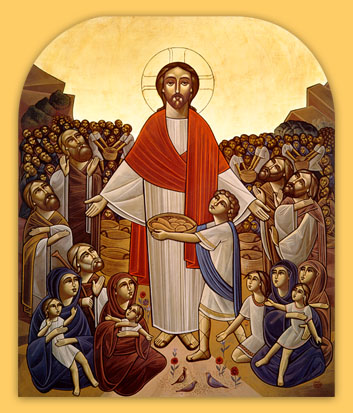
And in a chiasmic kind of way, that you wouldn't notice yet if I hadn't just boasted about the oh-so-clever construction of this piece, that picnic always takes me back to that other one (or two) where Jesus feeds 4 or 5 thousand men (plus the women and children - who aren't counted but are important enough, at least, to be remembered).
And that leads me onto the different ways of looking at these stories. For some such as Drayton Parslow - and myself, as it happens - believe that these are stories of real miracles. But others see it differently. The most commonly-held "less literal" way of believing in the stories is probably what I might call the "Galilean Bring-and-Share" tradition.
In the "Galilean Bring-and-Share" story, the exasperation of the disciples is mollified when it is discovered that a large proportion of the 5,000 men (and associated offspring and spouses) have in fact brought their lunch along after all. Opening the Roman-Era Tupperware (c) they doled out the kippers and cobs they had remembered to bring along. I will note that it's an odd thing that, although Jesus's teaching seems to have lasted all day on many occasions, his actual recorded sermons are in fact very short. But the point is that from a dramatic work of power that awes all around and leaves baskets full of uneaten food, now we have a little moral tale about the importance of generosity. Giving liberal preachers the world over the chance to prove their cleverness by showing the glaring inaccuracies in the Bible to their flocks, while also letting them encourage a decent display at the next "Faith lunch".
And to this I say Phooey. The point of the story is not that when you set off into the wilderness you should remember to take a packed lunch in case the bloke next to you is not so possessed of forethought. The point of the story is that Jesus is divine and capable of doing miracles. If you want to say it didn't literally happen - don't keep the story and take out the miracle and make it some pious bring-and-share tale. Chuck out the narrative and suburban explanation completely and say - the story shows simply that Jesus is divine. Multiplying food in unlikely locations is what supernatural beings do. So the disciples are trying to tell us that Jesus is the Son of God, by telling us he made lots of bread and wine when it was needed.
So do it that way. It's got great, simple, mythic power. And somebody can still read that and have a choice whether Jesus is the Son of God or not. Or tell it the old way. And the choice is there - it happened or it didn't, he's the Creator walking on earth and a human being - or he's not. But don't fall down the middle and pretend it's about not forgetting your sandwiches and being generous to others. Because it's not.
And back to that first story - it's a brilliant story. The surprise revelation, the remembrance of old things renewed. The human closeness to the supernatural conqueror of death. Again - take it as a literally and mythically true story. Or take it as a mythical story and celebration of Communion. But you're not gonna explain this one away by claiming it's about the communal importance of barbecues.
Friday, 30 September 2011
Late-night annoyance with an English mythical creature
Just caught Herne the Hunter taking a stroll across the meadow. And I told him good and strong.
I don't care if he is supposed to be a degenerate folk-memory of the Celtic god Cernunnos. That's no excuse for dropping his dog-ends on my footpath.
And while we're on the subject of dogs, if he's going to let Black Shuck "do his business" in the Community grounds, he can use a pooper-scooper like everyone else. I'm not giving any allowances for mythical beings.
I don't care if he is supposed to be a degenerate folk-memory of the Celtic god Cernunnos. That's no excuse for dropping his dog-ends on my footpath.
And while we're on the subject of dogs, if he's going to let Black Shuck "do his business" in the Community grounds, he can use a pooper-scooper like everyone else. I'm not giving any allowances for mythical beings.
Saturday, 24 September 2011
Richard Dawkins is Right
I've no idea how many schools really teach creationism, or want to. Richard Dawkins is, if nothing else, a relentless self-publicist so would probably campaign against it even if no schools were teaching it at all. When I was at St Agatha's School for the Slightly Unbalanced Children of Gentlefolk back around 1980, anyone trying to teach Creationism as a form of science would have been laughed out of court before they'd got as far as explaining how all the fossils were planted by the Dark One / were the skeletons of animals that died in the Flood. Someone did apparently manage to introduce a Creationist to a Christian Union meeting, but his theories regarding the speed of light slowing down were generally greeted with derision and rotten vegetables. Even the Christian Union at St Aggie's were a scary bunch.
It strikes me that if the churches of this country really want to get to grips with the Creation stories, they should do their best to stop the teaching of Creationism in churches. I know it's against Free Speech, but then we don't allow preachers to encourage the stoning of adulterers or claim that the wine in the New Testament was miraculously unfermented grape juice either, do we?
Actually - I've just quickly called Drayton Parslow. Turns out that he does claim that about the grape juice. But he says stoning is definitely illegal. Worryingly, he didn't say "wrong". Just "illegal".
But still, the reason teaching Creationism is wrong is because it does such an injustice to the Bible. Here in Genesis 1 we have a big story about an ordered Universe - a predictable Universe. A place where things work in line with rules. The light and the dark are separated, the lights are put in place, the sea is sea and the air is air and the animals walk and the fish swim and people are part of it. And it's all good. And God isn't a two-bit Babylonian god, making the earth out of bits of leftover other Gods. He's an ex-nihilo creator of order out of chaos. And if you think that last sentence was oxymoronic, you're right. And I don't care.
Then in Genesis 2-3 we have another big story - a dream of how things could be, where death isn't and God is just up the road and the man and the woman can live quiet lives doing useful things and then because humans are stupid and want their own way, things go wrong.
And in Genesis 4 we get that whole farmer and the rancher can be friends thing for the first time in history - the nomad against the pastoralist, the vegetarian against the meat-eater - Cain and Abel. But hatred has slunk in by now and things go wrong and we're into the world of blood feud - but also the world of technology and music and creativity.
And an understanding of genre means you can rend so much meaning out of these. There's wondering about the texts underlying - there's the pervasive "Younger versus Older Brother" motif that goes all the way through Genesis to the New Testament discussion of Jews and Gentiles depending how you read it. There's that stunning prophecy - especially on this day of Our Lady of Walsingham -
"And I will put enmity
between you and the woman,
and between your offspring and hers;
he will crush your head,
and you will strike his heel.”
So why, with this great and fascinating patchwork of myth and beauty, prophecy and folklore, national beginnings and deep psychology - why would any fool reduce Gen 1 to being mere science, and Gen 2-4 to history? For goodness' sake - get a grip. Read scientific truth out of scientific things, and read moral and psychological and religious truth out of Genesis. And then struggle with it, because this isn't simple stuff and there's a lot of symbol and imagery in there - and you know how slippy they are. I hate to say Dawkins is right - and I'm sure, as I say, that he's just drama queening it up for polemic effect - but when he says we shouldn't teach Creationism in schools, he's right. But I'd go further. We shouldn't allow the teaching of Creationism in churches. We'd shouldn't allow it in RE - except for humorous and satirical reasons. We don't allow the theory of the Lost Tribes of Israel in history, we don't allow flat-earthers to give advice in Geography, and we don't teach the principles of alchemy in Chemistry. We mention them as being wrong, and move on. So with Creationism - it's bad science and it's bad religion. And it's a dreadful way of approaching literature.
It strikes me that if the churches of this country really want to get to grips with the Creation stories, they should do their best to stop the teaching of Creationism in churches. I know it's against Free Speech, but then we don't allow preachers to encourage the stoning of adulterers or claim that the wine in the New Testament was miraculously unfermented grape juice either, do we?
Actually - I've just quickly called Drayton Parslow. Turns out that he does claim that about the grape juice. But he says stoning is definitely illegal. Worryingly, he didn't say "wrong". Just "illegal".
But still, the reason teaching Creationism is wrong is because it does such an injustice to the Bible. Here in Genesis 1 we have a big story about an ordered Universe - a predictable Universe. A place where things work in line with rules. The light and the dark are separated, the lights are put in place, the sea is sea and the air is air and the animals walk and the fish swim and people are part of it. And it's all good. And God isn't a two-bit Babylonian god, making the earth out of bits of leftover other Gods. He's an ex-nihilo creator of order out of chaos. And if you think that last sentence was oxymoronic, you're right. And I don't care.
Then in Genesis 2-3 we have another big story - a dream of how things could be, where death isn't and God is just up the road and the man and the woman can live quiet lives doing useful things and then because humans are stupid and want their own way, things go wrong.
And in Genesis 4 we get that whole farmer and the rancher can be friends thing for the first time in history - the nomad against the pastoralist, the vegetarian against the meat-eater - Cain and Abel. But hatred has slunk in by now and things go wrong and we're into the world of blood feud - but also the world of technology and music and creativity.
And an understanding of genre means you can rend so much meaning out of these. There's wondering about the texts underlying - there's the pervasive "Younger versus Older Brother" motif that goes all the way through Genesis to the New Testament discussion of Jews and Gentiles depending how you read it. There's that stunning prophecy - especially on this day of Our Lady of Walsingham -
"And I will put enmity
between you and the woman,
and between your offspring and hers;
he will crush your head,
and you will strike his heel.”
So why, with this great and fascinating patchwork of myth and beauty, prophecy and folklore, national beginnings and deep psychology - why would any fool reduce Gen 1 to being mere science, and Gen 2-4 to history? For goodness' sake - get a grip. Read scientific truth out of scientific things, and read moral and psychological and religious truth out of Genesis. And then struggle with it, because this isn't simple stuff and there's a lot of symbol and imagery in there - and you know how slippy they are. I hate to say Dawkins is right - and I'm sure, as I say, that he's just drama queening it up for polemic effect - but when he says we shouldn't teach Creationism in schools, he's right. But I'd go further. We shouldn't allow the teaching of Creationism in churches. We'd shouldn't allow it in RE - except for humorous and satirical reasons. We don't allow the theory of the Lost Tribes of Israel in history, we don't allow flat-earthers to give advice in Geography, and we don't teach the principles of alchemy in Chemistry. We mention them as being wrong, and move on. So with Creationism - it's bad science and it's bad religion. And it's a dreadful way of approaching literature.
Wednesday, 24 August 2011
Autonomous Self and Safety
It strikes me, in retrospect, that this morning's comments on Health and Safety may have been construed as no more than a rant. Which is fair enough - it was to a large extent. And so to counter this I may need to do some serious theological thinking on H&S.
Sorry. Where was I? Ah yes.You see, contrary to popular opinion, Health and Safety is not about the total elimination of risk. If it were, we'd all be dead. As the only way to ensure we're not the unfortunate victim of a road traffic accident is to stay in bed. And if everyone did that we'd all starve. Safely.
If anyone says that the only acceptable number of accidents is zero, then they don't understand the issue. The only way for a business - even an office acting as an arms-length value-added reseller of soft cushions - not to have any accidents is to do no trade. Never to open the door. And if the supermarkets and farmers (dangerous activity, farming) and fisherpeople (very dangerous activity, fishing) and transport hauliers all adopted this theory - we'd all starve to death.
And we care deeply about keeping children safe. But between the risk of infectious diseases, or of a frightening book allergy, and the danger of little Jimmy or, as it may be, Jade skinning their knees on the playground, you can't eliminate all risk from school, without closing all the schools. And the result of that, after the country lost all competitiveness in world markets, would be that we all eventually starved to death So you can see that the consequence of being very safe is starving to death, no matter how you look at it.
But some people are dim. Some don't have that aversion to falling from heights that most people have evolved. They may come from Holland or Norfolk, where having a fear of heights brings no real evolutionary advantage. So, specially for these people - or for the ones you've invited to a special "flat roof party" - put a parapet around, says the Good Book. That'll stop them inadvertently plummeting off while looking in the other direction. If they climb over the parapet - against all the training and the "Roof Instruction Manual" you gave them before letting them out - and they have removed the safety harness with which you fitted them, with its two hooks clamping them onto the safety rail you put on your parapet - if, after all that, you still see them dropping past the window with a startled look on your face - then it's their own fault. Their blood is not on your head (not, at least, unless you broke their fall). And the only people that will starve to death will be the lawyers.
This thinking starts with the reflection that from dust we came, and to dust we will return. However safe we try to make ourselves, our lives will end. And that gives a kind of comparison. If our lives were of endless natural duration, but we could lose them through accident, we would be far more careful than if our natural lifespans were 21 years - especially after the age of 20. What I'm saying is, it's all relative.
We shall have to make the assumption that we have a degree of free will. Clearly nobody has completely free will - their actions will always be influenced by current constraints, the state of their digestion, their upbringing and so on. But, on the other hand, if we have no free will and live in a totally deterministic universe, then we may as well resign ourselves to our fate. We would have no choice but to resign ourselves to whatever a capricious Universal Will decided what might be fun. Basically, in a deterministic universe there's no point running. If you're sure to get run over by a JCB you may as well go and lay down in its path and get it over with. No point hiding in a foreign country so somebody's got to go to all the trouble and expense of shipping a JCB out there, hunting you down and running you over. Where's the fun in that? And there's no sense hiding in your bed in your fifteenth-floor flat. Fate may have to take a lot of trouble getting the JCB up the stairs, but it'll make sure it happens.
No, we must have some free will or there is no point either in Health, or Safety. And we must assume we have some kind of responsibility, for no man is an island entire of itself. If you fall from the warehouse racking then there are not just consequences for you. There are consequences for your widow or widower. For your children. For your employer. For the lawyer whom your relict now will employ to sue the pants off the employer on a no-win, no-fee basis. For the bloke from the Health and Safety Executive, who was looking forward to slipping off early this Friday for a dirty weekend in Haywards Heath but will now have to schlep down to Daventry to inspect the white chalk outline where you previously lay. And the HSE bloke's missus isn't going to go unaffected in all this. Nor the hoteliers of Haywards Heath, who will have yet another cancelled booking to deal with. Before you know it (not that you will - because you've been scraped off the place where the white chalk outline is, and rolled up to fit in the box) there's a massive network of people all over the country mourning, making money, or with another bedroom to let, and all because you couldn't be bothered to get the airplane steps and just climbed up on the racking instead. And it's no good getting angry with you, because you're well out of it dead and left everybody else in it, you selfish so and so. Typical of you, that is, getting yourself killed and then not taking responsibility for the consequences.
Sorry. Where was I? Ah yes.You see, contrary to popular opinion, Health and Safety is not about the total elimination of risk. If it were, we'd all be dead. As the only way to ensure we're not the unfortunate victim of a road traffic accident is to stay in bed. And if everyone did that we'd all starve. Safely.
If anyone says that the only acceptable number of accidents is zero, then they don't understand the issue. The only way for a business - even an office acting as an arms-length value-added reseller of soft cushions - not to have any accidents is to do no trade. Never to open the door. And if the supermarkets and farmers (dangerous activity, farming) and fisherpeople (very dangerous activity, fishing) and transport hauliers all adopted this theory - we'd all starve to death.
And we care deeply about keeping children safe. But between the risk of infectious diseases, or of a frightening book allergy, and the danger of little Jimmy or, as it may be, Jade skinning their knees on the playground, you can't eliminate all risk from school, without closing all the schools. And the result of that, after the country lost all competitiveness in world markets, would be that we all eventually starved to death So you can see that the consequence of being very safe is starving to death, no matter how you look at it.
No, merely opening the door of the office in the morning - even going to the office - is taking a risk, however calculated and small. So we have to balance the good effects of industry against the risk and ill-effects of accident. And the proper role of Health and Safety is to get that balance right - keeping the risk of serious injury appropriately small while still going about our personal lives.
But there are things that weight towards the safe end. The obvious one being that the result of a serious accident of any kind is that a lawyer gets involved and it costs everyone a fortune. Whereas if we're all uber-safe, even the lawyers will starve to death. So the fear of big legal costs pushes us from the right balance point to a dangerously cowardly one. The answer in my opinion is to ban lawyers from ever going out of their houses, but apparently that increases the chances of them starving to death. And that's against Health and Safety.
Finally I will point out that among the oldest Health and Safety regulations we have is this from Dt 22:8
"When you build a new house, make a parapet around your roof so that you may not bring the guilt of bloodshed on your house if someone falls from the roof."In other words, it's not telling you not to let people walk around on your roof - for they have free will, and you may have a nice view from your roof. Why shouldn't people walk around on your roof, if you let them? Obviously, you want a bit of a veto. After all - it's your roof. You don't want just anyone up there. Especially not if they have a JCB and you suspect this may be a totally deterministic universe. But after appropriate training, and signing a waiver, and wearing a hi-viz and safety goggles and hard hat, why not tell them they can go ahead - have a walk on the roof.
But some people are dim. Some don't have that aversion to falling from heights that most people have evolved. They may come from Holland or Norfolk, where having a fear of heights brings no real evolutionary advantage. So, specially for these people - or for the ones you've invited to a special "flat roof party" - put a parapet around, says the Good Book. That'll stop them inadvertently plummeting off while looking in the other direction. If they climb over the parapet - against all the training and the "Roof Instruction Manual" you gave them before letting them out - and they have removed the safety harness with which you fitted them, with its two hooks clamping them onto the safety rail you put on your parapet - if, after all that, you still see them dropping past the window with a startled look on your face - then it's their own fault. Their blood is not on your head (not, at least, unless you broke their fall). And the only people that will starve to death will be the lawyers.
Wednesday, 13 July 2011
Drayton Bans Everything
What a lesson it is to us never totally to close ourselves off from the world. For if, like the ungodly monks of the Romish religion, we were to lock ourselves away into (strictly segregated) monasteries and nunneries - we would miss out so much news with which we can educate ourselves.
For example, I have been hearing about the people who, not content with boycotting the News of the World before it closed, are now boycotting all things from News International.
I was already refusing to buy any of News International's wares. The Sun because of page 3. The Times because Crosswords, being cryptic and arcane, are works of darkness. And all satellite TV because of Keeping up with the Kardashians. But then in the Parslow household we also shun the Guardian for its smug liberalism, the Telegraph for its pompous Toryism, and the Daily Mail and the Express because their health-scare stories bring on Marjory's hypochondria.
In more recent times, I have been studiously avoiding supermarkets. Do you realise, oh my brothers, that these brightly-lit dens of inquity sell - under the same roof - bottles of wine, boxes of chocolate, and packets of contraceptives. They are clearly encouraging the people of this country to debauchery.
Clearly I would never, under any circumstances, enter an off-licence - that is if any are left, now that the supermarkets' debauchery-under-one-roof strategy is in place. For in the old days, a libertine would have to visit an off-licence, a chocolatier and a barber's to accumulate his full nefarious shopping list.
Which reminds me. I am boycotting the barber's. When I was young, I used to think those boxes bearing the words "Safe, Effective Family Planning" was to do with creating a diary to co-ordinate one's children's out-of-school clubs and sports. But when I became a man, I discovered that these fiends with combs and Brylcreem were trying to encourage extra-curricular activities of a totally different kind. So from now on Marjory shall be giving me my six-weekly cut and blow dry.
I am also boycotting menswear shops on the grounds that they sell the kinds of low-slung jeans that the youth of today wear. And chemists, for all the above reasons more or less.
And so I find that I have boycotted nearly everything. Thankfully this year we can live off the fruit of the land - although Marjory is getting rather tired of raspberries and rhubarb, we have a fine crop of potatoes. But I have just realised, my brethren and their suitably-guarded womenfolk, that I am attempting to communicate with you through the medium of the Internet. That bastion of all things ghastly. And yet all this time I have been using its tainted telecommunications wires. Maybe it is time I decided to
Tuesday, 21 June 2011
Oppress Stonehenge's Neo-Pagan Hippies: Guardian
I was in such a good mood with the Guardian, as well. Comment is Free linked to this morning's post about the Pan in my kitchen. I was almost prepared to forgive them for Polly Toynbee.
But then I read a blog article that darkened my mood. "Save Stonehenge from Midsummer Madness", declares someone called Jonathan Jones.
Let's consider his argument -
"why is this daft festival even allowed?" he asks. Answer - because this is a free country and people, on the whole, are allowed to do what they like as long as they don't bother anyone else. And because English Heritage, quite rightly, allows it. If you don't like it, vote for the "Keep hippies out of Stonehenge" party at the next election. There isn't one - because there are no votes in it.
"In the 1980s hippies fought the police for their right to revel. So that is why it is permitted: because otherwise there would be public violence on Salisbury Plain," Mr Jones tells us. Well, if the reason for objecting to something is that people fought for their rights, then women wouldn't have the vote and the Poll Tax would still be with us. The actions of the authorities, particularly at the Battle of the Beanfield, strike me as intolerant and autocratic - picking a fight for no obvious reason. But perhaps the Guardian prefers the strong smack of authoritarianism from people in uniform?
And then to the crux of Mr Jones's argument - which has some force, in one way. He argues that (a) Stonehenge is aligned on the Midwinter, not Midsummer, Solstice and (b) The Druids never built Stonehenge.
In other words, people shouldn't be allowed to celebrate at Stonehenge because their history is bad.
To which I would respond - "So what?" I don't care if their history is bad, and the people at Stonehenge don't all claim to be Druids. They have come there in response to a sense of awe and wonder at things that they know are beyond them. The mere fact they're six months late (or early) and misinformed about Druids is neither here nor there.
Frankly if we were going to ban people from Stonehenge on the grounds that their history was bad, I'd start with certain (but not all - I wouldn't like to go in for blanket condemnations) American tourists. Apart from the one who, according to legend, thought it was due to some kind of eruption - I followed a group of them around last year and they reckoned Stonehenge must be "several hundred years old". Surely people so ignorant should be kept away from the stones, for fear they might accidentally walk straight into one and hurt themselves.
Mr Jones concludes with the following diatribe:
"The ancient stones should not be reduced to a stage for feeble pseudo-religious, pseudo-communal fantasies. There is something abusive and ugly about this annual festival of historical amnesia, a contemptuous lack of interest in the real people of past and their sublime creations."
Which, I think, can be summarised as "these people are not like us." On they other hand, they have "pseudo" community. And they have far more interest in the real people of the past than Mr Jones allows - because he produces no evidence, he is free from those most awkward of objects, facts. I know they have, because I've discussed what some of them actually do think about the "real people" of the past with them, and they're not ignorant of archaeology or history, They just like their history a little idealised of a Summer Solstice - a bit like most people's attitude to Christmas.
Mr Jones's argument, as best as I can tell, is that Stonehenge should be closed to neo-pagans because they lower the tone. To which I can only say - let us consider the people who, over the last 2 centuries, have really damaged the place.
In fourth place, I would put English Heritage themselves. They have built a crappy teahouse, ugly car park and nasty toilets just across the road.
In third place, I would put the old GPO, who nearly destroyed the Heel Stone with an automated trench-digging machine in 1979.
In second place, I would put the Army. They drove a mere 5 yards from the stones before the First World War, and trashed parts of the cursus. According to rumour, they wanted the whole thing flattened to make access to Lark Hill easier.
But the prize-winners for people who have wrecked most of Stonehenge are scientists. It was a group of archaeologists who, after the First World War, destroyed half the archaeology of the place and gained practically no knowledge. Not hippies, not pagans. Scientists. Who just kept digging, even when they knew there was nothing to find. Oh yes, I know that modern scientists disown their fore-runners - tell us that they aren't like they were then. These days they're more educated, more liberal - more understanding. But let nobody tell you that scientists aren't the biggest vandals that Stonehenge has ever known.
If you want to protect Stonehenge, I say - ban scientists not pagans.
And Heaven defend us if we ever allow Jonathan Jones to decide what religious practices he thinks should be allowed.
My history in this rant is mostly sourced from Christopher Chippindale's excellent, entertaining and learned Stonehenge Complete. I personally prefer the 2nd edition, which is less rushed in its later sections. However the 3rd is more up to date, obviously.
But then I read a blog article that darkened my mood. "Save Stonehenge from Midsummer Madness", declares someone called Jonathan Jones.
Let's consider his argument -
"why is this daft festival even allowed?" he asks. Answer - because this is a free country and people, on the whole, are allowed to do what they like as long as they don't bother anyone else. And because English Heritage, quite rightly, allows it. If you don't like it, vote for the "Keep hippies out of Stonehenge" party at the next election. There isn't one - because there are no votes in it.
"In the 1980s hippies fought the police for their right to revel. So that is why it is permitted: because otherwise there would be public violence on Salisbury Plain," Mr Jones tells us. Well, if the reason for objecting to something is that people fought for their rights, then women wouldn't have the vote and the Poll Tax would still be with us. The actions of the authorities, particularly at the Battle of the Beanfield, strike me as intolerant and autocratic - picking a fight for no obvious reason. But perhaps the Guardian prefers the strong smack of authoritarianism from people in uniform?
And then to the crux of Mr Jones's argument - which has some force, in one way. He argues that (a) Stonehenge is aligned on the Midwinter, not Midsummer, Solstice and (b) The Druids never built Stonehenge.
In other words, people shouldn't be allowed to celebrate at Stonehenge because their history is bad.
To which I would respond - "So what?" I don't care if their history is bad, and the people at Stonehenge don't all claim to be Druids. They have come there in response to a sense of awe and wonder at things that they know are beyond them. The mere fact they're six months late (or early) and misinformed about Druids is neither here nor there.
Frankly if we were going to ban people from Stonehenge on the grounds that their history was bad, I'd start with certain (but not all - I wouldn't like to go in for blanket condemnations) American tourists. Apart from the one who, according to legend, thought it was due to some kind of eruption - I followed a group of them around last year and they reckoned Stonehenge must be "several hundred years old". Surely people so ignorant should be kept away from the stones, for fear they might accidentally walk straight into one and hurt themselves.
Mr Jones concludes with the following diatribe:
"The ancient stones should not be reduced to a stage for feeble pseudo-religious, pseudo-communal fantasies. There is something abusive and ugly about this annual festival of historical amnesia, a contemptuous lack of interest in the real people of past and their sublime creations."
Which, I think, can be summarised as "these people are not like us." On they other hand, they have "pseudo" community. And they have far more interest in the real people of the past than Mr Jones allows - because he produces no evidence, he is free from those most awkward of objects, facts. I know they have, because I've discussed what some of them actually do think about the "real people" of the past with them, and they're not ignorant of archaeology or history, They just like their history a little idealised of a Summer Solstice - a bit like most people's attitude to Christmas.
Mr Jones's argument, as best as I can tell, is that Stonehenge should be closed to neo-pagans because they lower the tone. To which I can only say - let us consider the people who, over the last 2 centuries, have really damaged the place.
In fourth place, I would put English Heritage themselves. They have built a crappy teahouse, ugly car park and nasty toilets just across the road.
In third place, I would put the old GPO, who nearly destroyed the Heel Stone with an automated trench-digging machine in 1979.
In second place, I would put the Army. They drove a mere 5 yards from the stones before the First World War, and trashed parts of the cursus. According to rumour, they wanted the whole thing flattened to make access to Lark Hill easier.
But the prize-winners for people who have wrecked most of Stonehenge are scientists. It was a group of archaeologists who, after the First World War, destroyed half the archaeology of the place and gained practically no knowledge. Not hippies, not pagans. Scientists. Who just kept digging, even when they knew there was nothing to find. Oh yes, I know that modern scientists disown their fore-runners - tell us that they aren't like they were then. These days they're more educated, more liberal - more understanding. But let nobody tell you that scientists aren't the biggest vandals that Stonehenge has ever known.
If you want to protect Stonehenge, I say - ban scientists not pagans.
And Heaven defend us if we ever allow Jonathan Jones to decide what religious practices he thinks should be allowed.
My history in this rant is mostly sourced from Christopher Chippindale's excellent, entertaining and learned Stonehenge Complete. I personally prefer the 2nd edition, which is less rushed in its later sections. However the 3rd is more up to date, obviously.
Wednesday, 8 June 2011
Male Archdruids
Once again I'm being nagged as to why there is a so-called "glass ceiling" for men in the Beaker Folk. Why, they ask me, is Hnaef merely Executive Arch-assistant to the Archdruid?
And in reply, I normally point out that it's not a glass ceiling. It's an 18th century original feature ceiling, with concrete reinforcement, a bodged Artex job, large authentic original oak rafters, a bit of mildew and a big sign saying "Beware of the low ceiling". Especially if you're a 6'2" assistant in walking boots.
But then I also point out that men are, as a whole, less sensitive, less emotionally attached, less empathetic. Less gentle. With no real sense for colour, or the appropriate use of scented tea lights. And a lot more needy - men spend all their time trying to ensure that their egos are stroked (if you're lucky). They break their legs and sustain other injuries playing football, and then when they hit 44 they have a mid-life crisis and dye their hair or spend all their time at work. Followed shortly afterwards by a heart attack and a gradual decline. Also, being on the whole big and lumpy, they've no grace. They go a bit flaky.
In short, they're the weaker sex. They don't provide the sort of stability we need round here. In a crisis, they're liable to go off collecting train numbers on the Marston Vale Line when they should be open to the hurt, suffering and needfulness around them.
And if you really want male leaders, you can join the Church of England. I believe they've loads of them.
And in reply, I normally point out that it's not a glass ceiling. It's an 18th century original feature ceiling, with concrete reinforcement, a bodged Artex job, large authentic original oak rafters, a bit of mildew and a big sign saying "Beware of the low ceiling". Especially if you're a 6'2" assistant in walking boots.
But then I also point out that men are, as a whole, less sensitive, less emotionally attached, less empathetic. Less gentle. With no real sense for colour, or the appropriate use of scented tea lights. And a lot more needy - men spend all their time trying to ensure that their egos are stroked (if you're lucky). They break their legs and sustain other injuries playing football, and then when they hit 44 they have a mid-life crisis and dye their hair or spend all their time at work. Followed shortly afterwards by a heart attack and a gradual decline. Also, being on the whole big and lumpy, they've no grace. They go a bit flaky.
In short, they're the weaker sex. They don't provide the sort of stability we need round here. In a crisis, they're liable to go off collecting train numbers on the Marston Vale Line when they should be open to the hurt, suffering and needfulness around them.
And if you really want male leaders, you can join the Church of England. I believe they've loads of them.
Sunday, 5 June 2011
Getting your priorities right
The news from Germany is that "locally-grown bean-sprouts" may have caused the E-coli outbreak. Which caused a certain confusion in the pub this evening, as people wondered where in the East of England they were growing bean-sprouts. Until we explained that the news report meant, local to Germany. Not local to the TV viewers.
Apparently, "The BBC's Stephen Evans in Berlin says the announcement may cause embarrassment to German authorities, who had earlier pointed to Spanish farms as the source of the outbreak."
Because that's really important, isn't it? 22 people have died. And the most important thing is not, calmly and responsibly, to prevent more deaths. No. The most important thing is to consider whether any public authorities might be embarrassed.
Stuff the embarrassment. Forget political considerations. When something is wrong, work out why it's wrong. And then stop it. You can be embarrassed later, when people stop dying.
Apparently, "The BBC's Stephen Evans in Berlin says the announcement may cause embarrassment to German authorities, who had earlier pointed to Spanish farms as the source of the outbreak."
Because that's really important, isn't it? 22 people have died. And the most important thing is not, calmly and responsibly, to prevent more deaths. No. The most important thing is to consider whether any public authorities might be embarrassed.
Stuff the embarrassment. Forget political considerations. When something is wrong, work out why it's wrong. And then stop it. You can be embarrassed later, when people stop dying.
Monday, 30 May 2011
The Pacific Age
I am grateful to that prolific and entertaining member of the Twitterati, Londiensis, for altering me to the news that Germany is planning to close all its nuclear power plants over the next decade. Apparently due to the Fukushima incident in Japan. This is a country that obtained nearly a quarter of its power from nuclear (and doesn't suffer from earthquakes). What strikes me is that if Plan A was at some stage nuclear power, Germany's not got many rational Plans B. It seems that Germany has a few options now. It can move towards greater energy efficiency at a stunning rate. It can once again start exploiting its coal fields. Or it can become dependent upon Russian gas. Or the people of Germany can sit in their cold houses on cold winter nights, having burnt down the last of the Schwarzwald to keep warm, and listen for the wolves of winter to close in. *** And, thanks to Peter Kirk, I should add that the current Plan B is actually to build loads of wind turbines. I apologise for a lack of research here, but think my point still stands - not least since the change in policy has brought the closure of the reactors forward by an average of 12 years.
We seem to be in a cleft stick. One where we want to continue with the consumption of our past - but we don't want to pay for it, either financially or environmentally. Yet we pay for pointless and inefficient wind turbines, which fail when the wind doesn't blow. And cover houses with expensive solar panels, which don't work when the sun doesn't shine. We can't burn coal because we don't want the carbon emissions, and we're scared of nuclear. In short, we've lost our nerve and our vision for the future. And we've no idea of a way out.
In the States, the problems seem worse and the solutions more gormless. The Government's response to a lack of growth is to pump more borrowed imaginary money into the economy. And yet, deep down - if the threat to the world is the consumption of resources - how can growth be the measure be which we drive our economies? Surely growth - the production of things from other things, using energy, which must be produced from fossil fuels or nuclear power, carried around by powered transport - surely growth is the enemy of the environment? Why are the visionaries of the West not putting forward their policies for the only rational strategy - a managed reduction in the size of our economies? How can growth, measured in the gross way it is, be good? And how could an economy like, say, Ireland's, based on debt and property prices, ever have been thought a success - even before the rug was pulled from under it?
Meanwhile there's China. A country with confidence. A country with faith in the future. A country that opens a coal-fired power station every few days. A place making itself rich producing the cheap rubbish with which we make ourselves comfortable in our fin-de-siecle, life-fearing, future-fearing decline. As the sun sets in the West, it's rising with a vengeance in parts of the East.
Those prophets of a quarter of a century ago, Humphreys and McCluskey, when they weren't annoying Ray Barnes with their dancing didn't just pretend to see what the future would hold:
The Pacific Age is growing strong
Its arms embrace with a killing grace
It shakes your hand as it takes your place.
Once our politicians were dreamers, visionaries, powerful people - people that could set up an NHS, fight a World War when the nation's back was against the wall, even - dare I say it - take on the Unions. Now they smile their shiny-faced smiles while they watch their country's decline. Ed, Dave, Nick - they're interchangeable, they're optional, they're not much good. Just tweaking the crenellations on the sand-castle as the Pacific tide comes in. We've lost our vision, we've lost our way. We've no prophets - just the amusing, made-for-TV ones like Howard Campings. We've no real poets - just the re-hashers of old songs for Reality TV talent-show winners. We're not going crossing any deserts, because we've no Promised Land. So we'll drive miles to the bottle bank to recycle bottles, while we plan our next cheap plane flight for our next cheap holiday. Then we'll suddenly notice how expensive food's getting, and petrol, and wonder why. We'll play with our technology. We'll buy our smart phones. And we'll sit and get washed away with the rest of the West and no-one will miss us. And our children, assuming they can still afford food, will have to learn to make cheap clothes for the Pacific consumers of the future.
Sorry, bouncy happy thoughts will resume tomorrow. You know what it's like, a wet Bank Holiday.
We seem to be in a cleft stick. One where we want to continue with the consumption of our past - but we don't want to pay for it, either financially or environmentally. Yet we pay for pointless and inefficient wind turbines, which fail when the wind doesn't blow. And cover houses with expensive solar panels, which don't work when the sun doesn't shine. We can't burn coal because we don't want the carbon emissions, and we're scared of nuclear. In short, we've lost our nerve and our vision for the future. And we've no idea of a way out.
In the States, the problems seem worse and the solutions more gormless. The Government's response to a lack of growth is to pump more borrowed imaginary money into the economy. And yet, deep down - if the threat to the world is the consumption of resources - how can growth be the measure be which we drive our economies? Surely growth - the production of things from other things, using energy, which must be produced from fossil fuels or nuclear power, carried around by powered transport - surely growth is the enemy of the environment? Why are the visionaries of the West not putting forward their policies for the only rational strategy - a managed reduction in the size of our economies? How can growth, measured in the gross way it is, be good? And how could an economy like, say, Ireland's, based on debt and property prices, ever have been thought a success - even before the rug was pulled from under it?
Meanwhile there's China. A country with confidence. A country with faith in the future. A country that opens a coal-fired power station every few days. A place making itself rich producing the cheap rubbish with which we make ourselves comfortable in our fin-de-siecle, life-fearing, future-fearing decline. As the sun sets in the West, it's rising with a vengeance in parts of the East.
Those prophets of a quarter of a century ago, Humphreys and McCluskey, when they weren't annoying Ray Barnes with their dancing didn't just pretend to see what the future would hold:
The Pacific Age is growing strong
Its arms embrace with a killing grace
It shakes your hand as it takes your place.
Once our politicians were dreamers, visionaries, powerful people - people that could set up an NHS, fight a World War when the nation's back was against the wall, even - dare I say it - take on the Unions. Now they smile their shiny-faced smiles while they watch their country's decline. Ed, Dave, Nick - they're interchangeable, they're optional, they're not much good. Just tweaking the crenellations on the sand-castle as the Pacific tide comes in. We've lost our vision, we've lost our way. We've no prophets - just the amusing, made-for-TV ones like Howard Campings. We've no real poets - just the re-hashers of old songs for Reality TV talent-show winners. We're not going crossing any deserts, because we've no Promised Land. So we'll drive miles to the bottle bank to recycle bottles, while we plan our next cheap plane flight for our next cheap holiday. Then we'll suddenly notice how expensive food's getting, and petrol, and wonder why. We'll play with our technology. We'll buy our smart phones. And we'll sit and get washed away with the rest of the West and no-one will miss us. And our children, assuming they can still afford food, will have to learn to make cheap clothes for the Pacific consumers of the future.
Sorry, bouncy happy thoughts will resume tomorrow. You know what it's like, a wet Bank Holiday.
Subscribe to:
Posts
(
Atom
)